

Blog
Idempotency in MuleSoft: Preventing Duplicate API Requests Processing
- March 04, 2026
- Gayathri Mhetre
Introduction: Why Duplicate Processing Is a Hidden Risk
In modern integration landscapes, APIs operate in distributed environments where failures are inevitable. Idempotent API design ensures that duplicate API requests do not create multiple transactions.
Network timeouts, retries, and system delays are common.
But these conditions introduce a critical risk:
The same request being processed multiple times.
In high-impact scenarios such as:
- Payments
- Orders
- Financial transactions
duplicate processing can lead to serious consequences.
Idempotency is the design principle that ensures a request is processed only once, even if it is received multiple times.
What Is Idempotency?
Idempotency means that multiple identical requests produce the same result as a single request.
In MuleSoft, idempotency ensures that:
- A message is processed once
- Duplicate requests are detected and ignored
- Data consistency is maintained across systems
This is especially important when requests are retried due to timeouts or network issues.
Real-Life Scenario
Consider a common payment use case:
- A user clicks “Pay” in a mobile application
- The internet connection is slow
- The user clicks the button again
- The same request is sent twice
Without Idempotency
- The payment is processed twice
- Money is deducted twice
With Idempotency
- The first request is processed
- The second request is detected as a duplicate
- No additional charge is made
This protection mechanism is known as idempotency.
Why Do Duplicate Requests Occur?
Duplicate requests are very common in distributed systems due to:
- Network interruptions
- Client-side retries
- API retry policies
- Timeout errors
- Event replays
Without proper handling, these duplicates can cause serious business issues.
Why Idempotency Is Important in MuleSoft
FAMuleSoft integrations frequently handle sensitive business data such as:
- Orders
- Payments
- Invoices
- Journal entries
- Events
Processing the same request multiple times can lead to:
- Duplicate records
- Financial discrepancies
- Data inconsistency
- Compliance issues
Implementing idempotency is essential for building reliable and enterprise-grade APIs.
MuleSoft Idempotent Message Validator
MuleSoft provides the Idempotent Message Validator to handle duplicate messages automatically.
Key Features
- Validates message uniqueness using a unique identifier
- The identifier can be extracted from:
- Request headers
- Query parameters
- Payload
- A DataWeave expression
- Filters out duplicate messages
- Throws a MULE:DUPLICATE_MESSAGE error for duplicates
Example: Using Query Parameters as a Unique ID
In this example, the id query parameter is used as the idempotency key.
<flow name=”myFlow”>
<http:listener
doc:name=”HTTP Listener”
config-ref=”HTTP_Listener_config”
path=”/”/>
<idempotent-message-validator
doc:name=”Idempotent Message Validator”
idExpression=”#[attributes.queryParams.id]”/>
</flow>
If the same id is received again, the message is automatically rejected.
How MuleSoft Helps – Object Store
MuleSoft provides Object Store, which acts as a lightweight internal storage mechanism.
What Is Object Store?
- A key–value storage provided by MuleSoft
- Used to store and retrieve data during application runtime
- Available as:
- Persistent Object Store
- In-memory Object Store
Object Store is commonly used to track processed idempotency keys.
Step-by-Step: Implementing Idempotency Using Object Store
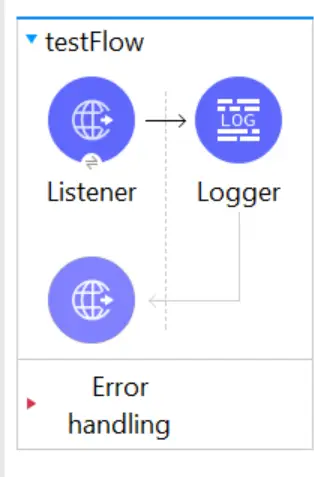
Step 1: Create a Basic Mule Flow
Create a flow with:
- HTTP Listener
- Logger
Step 2: Configure Object Store
Before using Object Store, configure it globally.
Steps in Anypoint Studio:
- Go to Global Elements
- Click Create
- Search for Object Store
- Select Object Store v2
- Provide a name (e.g., ObjectStore_Config)
- Choose Persistent storage

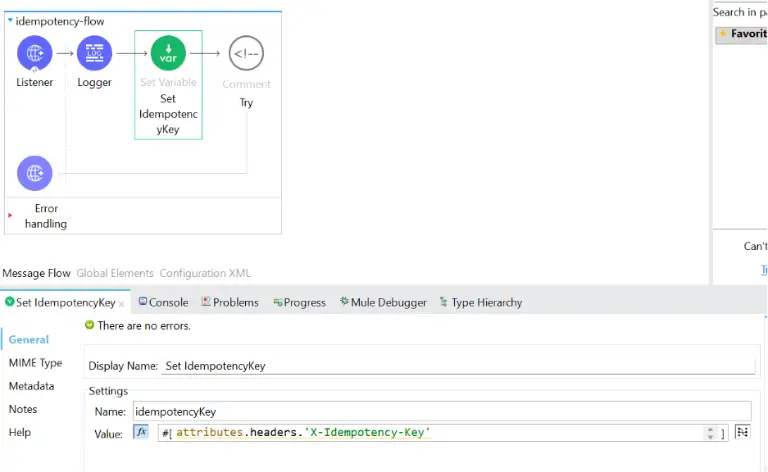
Step 3: Extract the Idempotency Key
Extract the idempotency key from request headers.
Header Name:
X-Idempotency-Key
Store it in a variable:
Vars.idempotencyKey
Step 4: Retrieve Key from Object Store
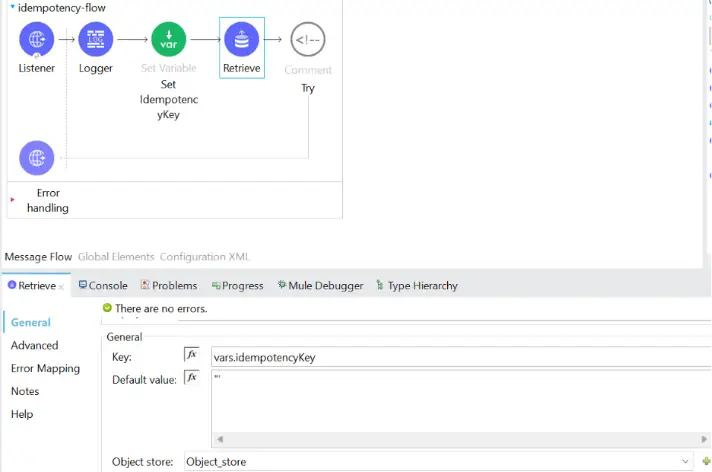
Add Object Store → Retrieve operation.
- Key: vars.idempotencyKey
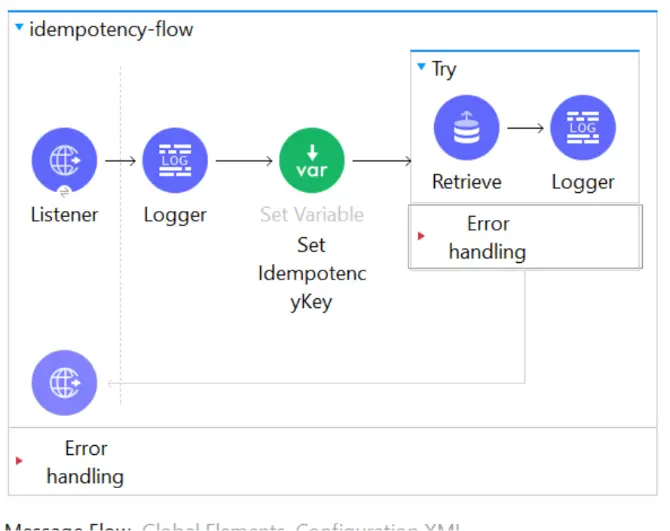
Step 5: Handle Duplicate Requests
- If the key exists → duplicate request
- If the key does not exist → continue processing
Use a Try scope to handle retrieval and duplicate detection.
Step 6: Process Business Logic
This is where your actual business logic resides, such as:
- Creating an order
- Calling downstream APIs
- Writing to a database
Step 7: Store the Key After Successful Processing
Once processing is successful, store the key in Object Store.
- Key: vars.idempotencyKey
- Value: PROCESSED
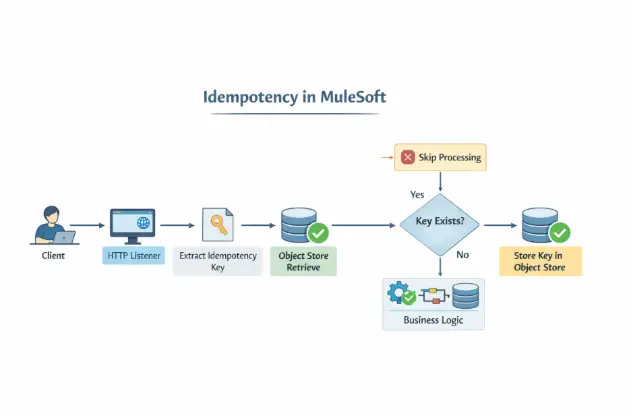
Idempotency Flow Overview
Client Request
|
Extract Idempotency Key
|
Object Store Retrieve
|
+– Key Exists? —> YES —> Skip Processing
|
Process Business Logic
|
Store Key in Object Store
Conclusion: Reliability Starts with Idempotency
Idempotency is not just a technical concept—it is a business safeguard.
By leveraging:
- Idempotent Message Validator
- Object Store
MuleSoft enables organizations to:
- Prevent duplicate processing
- Protect financial and transactional data
- Ensure system reliability
- Maintain data consistency
In enterprise integration, reliability is not optional.
And reliability begins with ensuring every request is processed exactly once.

Author: Gayathri Mhetre
Frequently Asked Questions:
Idempotency ensures that multiple identical API requests produce the same result as a single request, preventing duplicate processing.
It prevents duplicate transactions, ensures data consistency, and protects systems handling critical operations like payments and orders.
MuleSoft uses components like the Idempotent Message Validator and Object Store to detect and prevent duplicate requests.
It is a MuleSoft component that checks message uniqueness using a key and rejects duplicate messages automatically.
Object Store is a key-value storage mechanism used to store idempotency keys and track processed requests during runtime.
You store a unique request key, check if it exists before processing, and skip execution if the key is already present.
Common causes include network failures, retries, timeouts, event replays, and client-side resubmissions.
An idempotency key is a unique identifier included in a request that helps detect whether the request has already been processed.
Critical use cases include payments, order processing, invoice generation, financial transactions, and event-driven systems.
They improve reliability, prevent duplicate API requests processing, ensure data accuracy, and enhance system resilience in distributed environments.