

Blog
Natural Language to SQL Automation in MuleSoft Using AI Chain
- February 17, 2026
- Saddam Hussain Shaik
Enabling Conversational Data Access Through Intelligent Integration
Introduction: When Data Exists but Insights Don’t
In modern enterprises, data is everywhere.
It lives in:
- CRM platforms
- ERP systems
- Finance tools
- Operational databases
- Internal applications
Yet accessing this data often requires technical knowledge of SQL, database structures, and query logic. For many business users, this creates a barrier between questions and answers.
As a result:
- Valuable insights remain unused
- Decisions are delayed
- Technical teams become bottlenecks
Natural Language SQL automation in MuleSoft addresses this gap by allowing users to interact with enterprise data using simple, everyday language.
By combining MuleSoft AI Chain with large language models (LLMs), organisations can:
- Translate natural language into SQL
- Execute queries securely
- Deliver insights in real time
This approach transforms MuleSoft from a traditional integration platform into an intelligent data access layer.
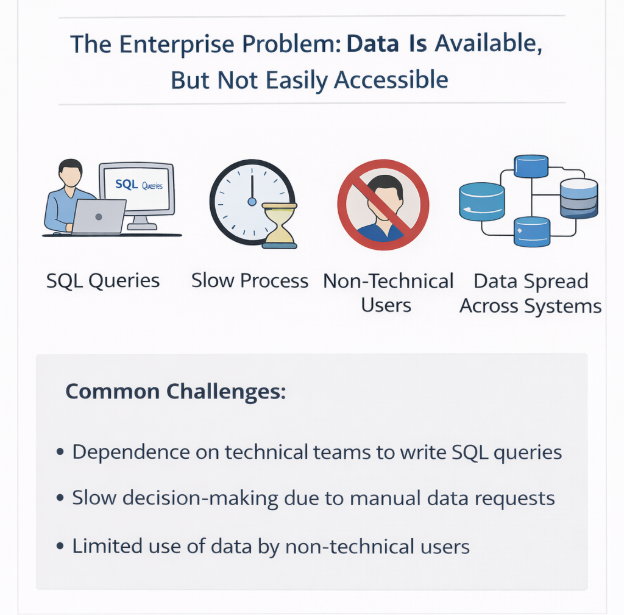
1. The Enterprise Problem: Data Is Available, But Not Easily Accessible
Modern enterprises use many systems such as CRM, ERP, finance platforms, and operational tools. These systems store valuable data, but accessing it is not easy.
Common challenges include:
- Dependence on technical teams to write SQL queries
- Slow decision-making due to manual data requests
- Limited use of data by non-technical users
- Data spread across multiple systems
To overcome these challenges, enterprises need an intelligent integration layer that understands human language and converts it into database queries.
2. MuleSoft AI Chain: From Integration to Intelligence
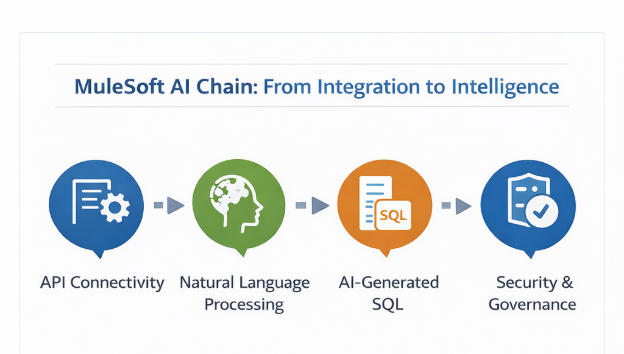
MuleSoft has always helped enterprises connect systems and manage APIs. With AI Chain capabilities, MuleSoft goes beyond integration and adds intelligence to data flows.
Natural Language to SQL Automation combines:
- API-led connectivity
- AI-based language understanding
- Automatic SQL generation
- Enterprise-level security and governance
Instead of treating AI as a separate tool, this approach embeds AI directly into MuleSoft integration architecture.
3. What Is Natural Language for SQL Automation?
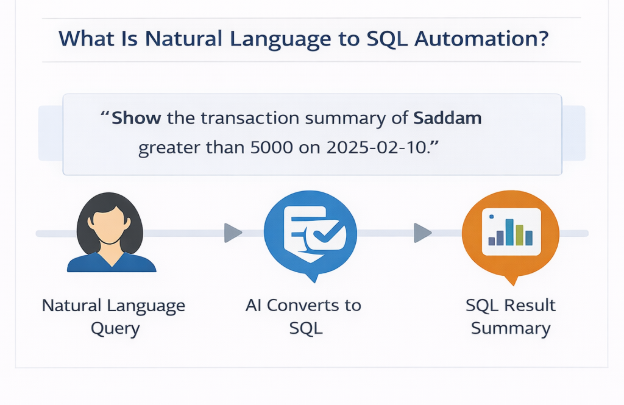
Natural Language SQL Automation allows users to interact with databases using everyday language.
Key Features
- Understands natural language queries
- Creates structured query plans
- Generates SQL using AI
- Executes queries securely
- Converts results into simple summaries
Example Query
“Show the transaction summary of Saddam greater than 5000 on 2025-02-10.”
The system automatically converts this request into SQL, executes it, and returns a clear answer.
Ex: Question:
—————–
{
“query”: “Give me summary of customer saddam”
}
Answer:
————
Saddam is an active customer with 12 transactions and a total spending of ₹58,500. His average transaction value is ₹4,875, with 5 high-value transactions exceeding ₹5,000. The most recent transaction was recorded on 2025-02-10, indicating ongoing engagement with the system. Overall, Saddam demonstrates consistent purchasing behavior and represents a valuable customer with potential for targeted offers and retention strategies.
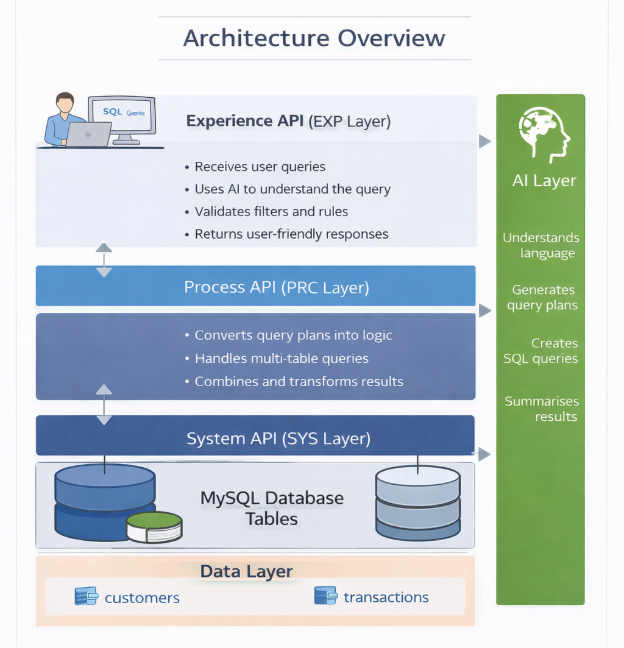
4. Architecture Overview
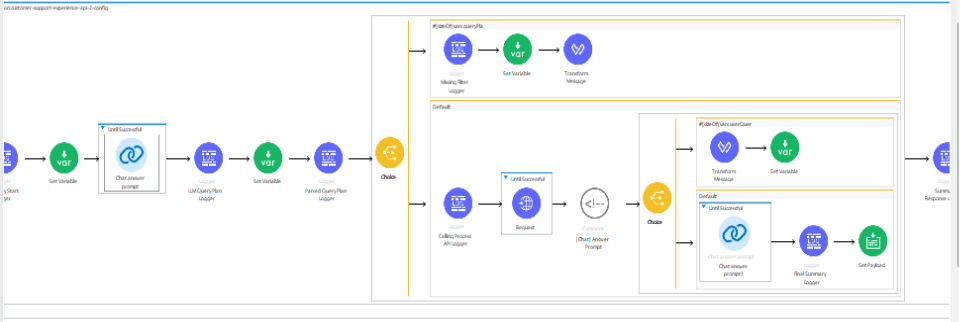
The solution follows MuleSoft’s API-led architecture.
Experience API (EXP Layer)
- Receives user queries
- Uses AI to understand the query
- Validates filters and rules
- Returns user-friendly responses
Process API (PRC Layer)
- Converts query plans into logic
- Handles multi-table queries
- Combines and transforms results
System API (SYS Layer)
- Connects to databases
- Generates SQL using AI
- Executes SQL using MuleSoft DB connectors


AI Layer
- Understands language
- Generates query plans
- Creates SQL queries
- Summarises results
Data Layer
- MySQL database
- Tables like customers and transactions
This layered design makes the solution scalable, secure, and easy to maintain.
5. How the System Works (End-to-End Flow)
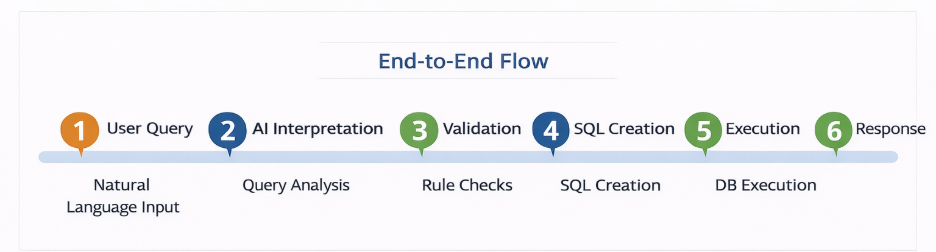
- The user (customer support agent) asks a question in normal English, such as:
“Show Saddam’s purchases between 1000 and 4000.”
- The AI inside MuleSoft converts this natural sentence into a correct SQL query.
Example: SELECT * FROM orders WHERE customerName = ‘Saddam’ AND amount BETWEEN 1000 AND 4000;
- MuleSoft executes that AI-generated SQL query on the MySQL database.
- The AI then summarizes the result, so the support team gets a clean, easy answer — not raw tables or complex data.
6. Business Benefits
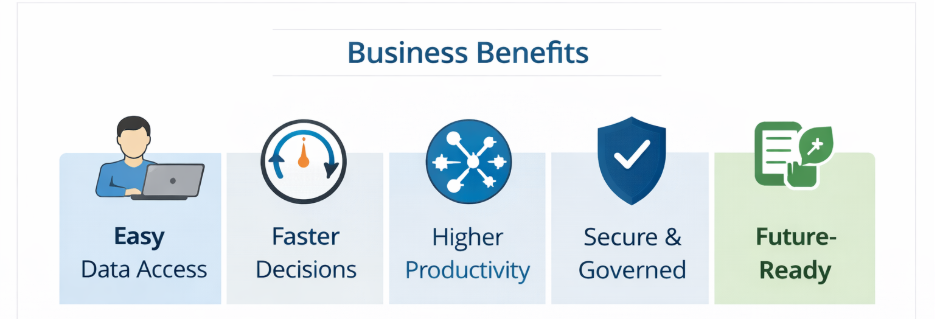
1. Easy Data Access
Business users can get data without knowing SQL.
2. Faster Decisions
Real-time queries help teams make quicker decisions.
3. Higher Productivity
Reduces dependency on developers and data teams.
4. Secure and Governed
MuleSoft ensures security, monitoring, and compliance.
5. Future-Ready
The solution can be extended to more systems and datasets.
7. Real-World Use Cases
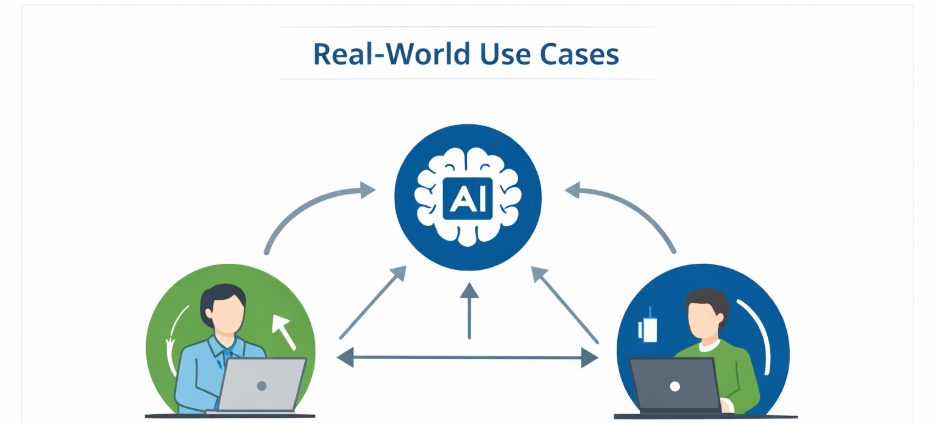
Customer Support
- Quickly view customer transaction history
- Improve response time
Business Analytics
- Query reports using natural language
- Explore data easily
Banking and Finance
- Analyse spending patterns
- Support risk and compliance
Sales and CRM
- Get real-time customer insights
Enterprise Knowledge Access
- Build conversational interfaces over enterprise data access
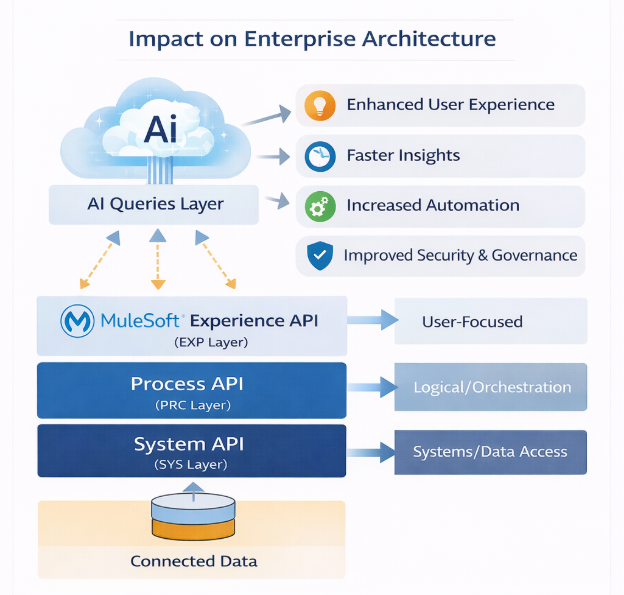
8. Impact on Enterprise Architecture
Natural Language to SQL Automation changes how enterprises interact with data.
By embedding AI into MuleSoft:
- APIs become intelligent services
- Business language connects directly to systems
- Automation becomes smarter and more human-like
This makes MuleSoft a powerful platform for AI-driven integration.
Conclusion: Toward Conversational Enterprises
Natural Language to SQL automation enables a major shift:
- From technical data access
- To conversational data access
By combining MuleSoft AI Chain architecture with enterprise databases, organisations can:
- Unlock faster insights
- Improve productivity
- Enable smarter decision-making
Soon, conversational data access will not be a competitive advantage.
It will be a baseline expectation for modern enterprises.

Author: Saddam Hussain Shaik
Frequently Asked Questions:
Natural language to SQL automation allows users to query databases using everyday language, which is automatically converted into structured SQL queries by AI.
MuleSoft uses AI Chain and large language models to interpret user questions, generate SQL queries, execute them securely, and return summarized results.
It removes the dependency on technical teams for data access, allowing business users to retrieve insights without writing SQL queries.
MuleSoft AI Chain is a set of AI-powered connectors and components that embed intelligence into integration flows for tasks like language understanding and automation.
Yes. MuleSoft enforces governance, authentication, and monitoring policies to ensure secure and compliant database access.
Customer support teams, business analysts, sales teams, and non-technical users can access data without needing SQL or database expertise.
An AI model interprets the user’s intent, creates a query plan, generates SQL based on database structure, and executes it through MuleSoft connectors.
Typical use cases include customer transaction lookups, sales insights, financial analysis, operational reporting, and internal knowledge queries.
The solution uses Experience, Process, and System APIs, with an AI layer that interprets language and generates SQL within the conversational integration flow.
It enables faster decision-making, improves productivity, and allows non-technical teams to interact with data directly using natural language.