
Blog
Informatica MDM: Architecture, Benefits & Implementation Guide
- October 27, 2026
- Pranavi Dharma
- Marketing Associate
Most enterprises do not have a shortage of data.
They have too many versions of the same data.
One customer may appear differently in Salesforce, ERP, billing, support, ecommerce, and marketing systems. A supplier can have different names, addresses, identifiers, and payment details across procurement and finance. Product information may be updated in one platform while an older version remains active somewhere else.
Every system can be technically correct from its own point of view.
The enterprise still ends up with conflicting versions of the truth.
That is the problem Master Data Management (MDM) is designed to solve.
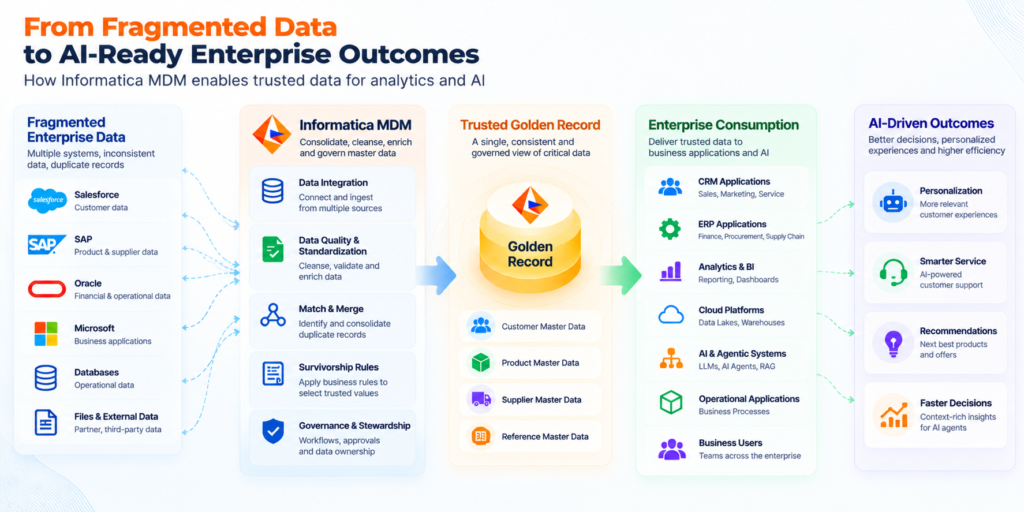
Informatica MDM helps organizations bring critical business data together, improve its quality, identify duplicate records, apply matching and survivorship rules, and create trusted master records that can be shared across applications, analytics platforms, business processes, and AI initiatives.
And that last point is becoming increasingly important.
As enterprises move from dashboards and automation toward AI assistants and autonomous agents, the quality of the context those systems receive becomes a business issue, not simply a data-management issue.
AI cannot reliably act on customer, supplier, product, or operational context if the enterprise itself cannot agree on which data is trusted.
That makes MDM increasingly relevant not only to data teams, but also to CIOs, enterprise architects, AI leaders, integration teams, and business transformation programs.
What Is Informatica MDM?
Informatica Master Data Management provides capabilities for creating and managing trusted views of important enterprise data domains such as customers, products, suppliers, reference data, and other business entities.
Informatica’s current MDM and 360 portfolio is powered by its Intelligent Data Management Cloud (IDMC), and includes offerings such as:
- Customer 360
- Supplier 360
- Product 360
- Reference 360
- Multidomain MDM SaaS
The broader goal is not simply to copy information into another database.
It is to establish a governed process for determining:
Which records represent the same real-world entity?
Which values should be trusted when systems disagree?
Who owns the data?
How should relationships and hierarchies be represented?
Where should the trusted record be distributed afterward?
Informatica describes modern MDM as providing unified 360-degree views of distributed master data across hybrid and cloud environments. Its current cloud offering also brings together integration, data quality, reference-data management, governance and other data-management capabilities around the mastering process.
The Problem MDM Solves
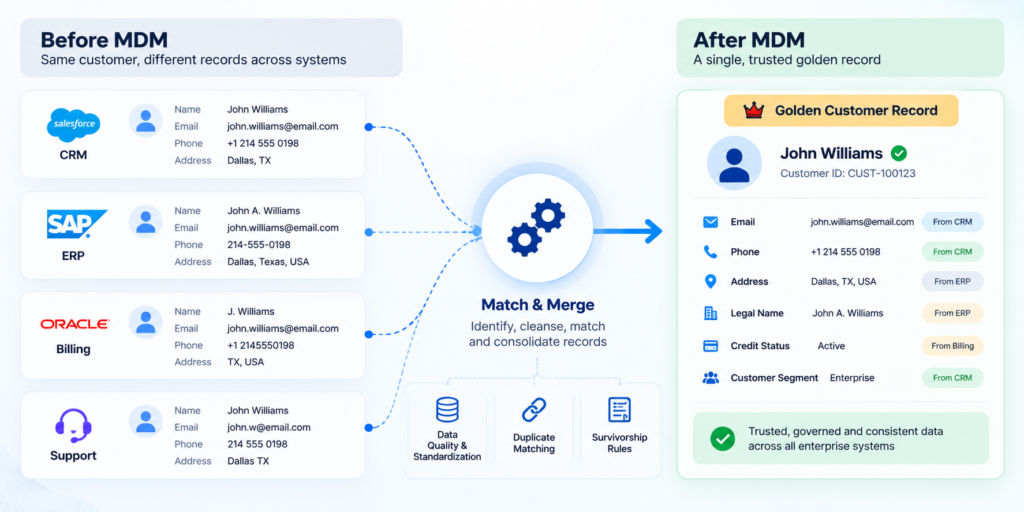
Consider a customer named John Williams.
The CRM contains:
John Williams
john.williams@email.com
+1 214 555 0198
The ecommerce platform stores:
John A. Williams
john.williams@email.com
214-555-0198
The billing system contains:
J. Williams
john.williams@email.com
+1 2145550198
The support platform may have another variation.
To a human, these may clearly represent the same person.
To disconnected enterprise systems, they may represent four different customers.
That affects far more than reporting.
Marketing might contact the same person multiple times.
Customer service may not see their complete history.
Revenue analytics may double-count the customer.
AI assistants may receive fragmented context.
Compliance teams may struggle to identify where personal data exists.
MDM introduces a governed process for identifying those relationships and creating a trusted representation of the entity.
What Is a Golden Record?
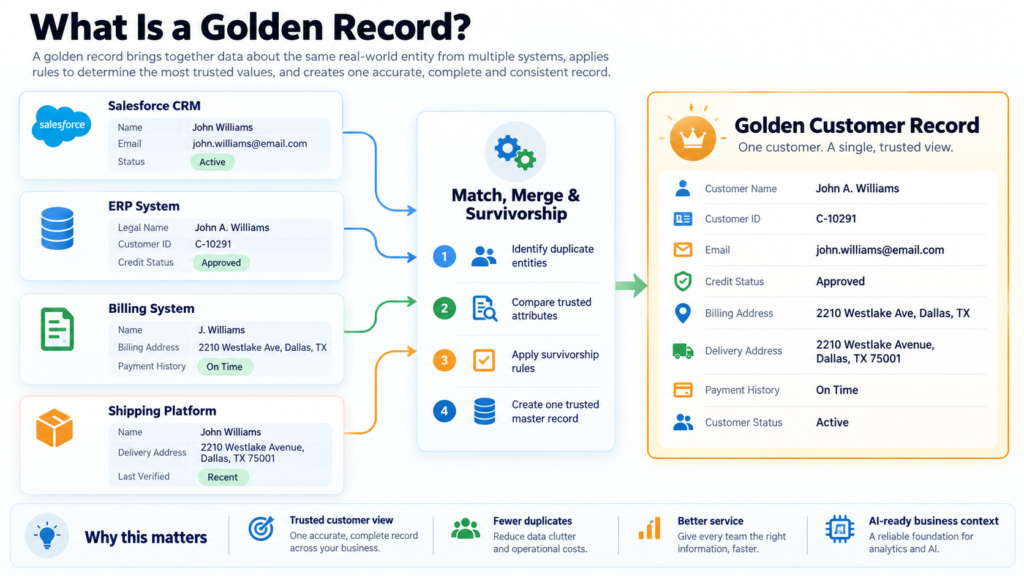
One of the most important concepts in MDM is the golden record, sometimes described more generally as the trusted master record.
A golden record represents the organization’s best available version of an entity after relevant source records have been:
identified → standardized → matched → merged → governed
The key word is trusted.
MDM does not simply choose one source system and declare everything inside it correct.
Different systems may be authoritative for different attributes.
For example:
- CRM may be the preferred source for email address.
- Billing may contain the most reliable legal name.
- ERP may own credit status.
- A shipping platform may have the most recently validated delivery address.
Informatica’s survivorship capabilities are designed to determine which values should populate the master record when matching source records contain conflicting information. Source ranking, data quality, recency and other criteria can participate in that decision.
The result is not just cleaner data.
It is an explainable mechanism for determining why a particular value is trusted.
How Informatica MDM Works
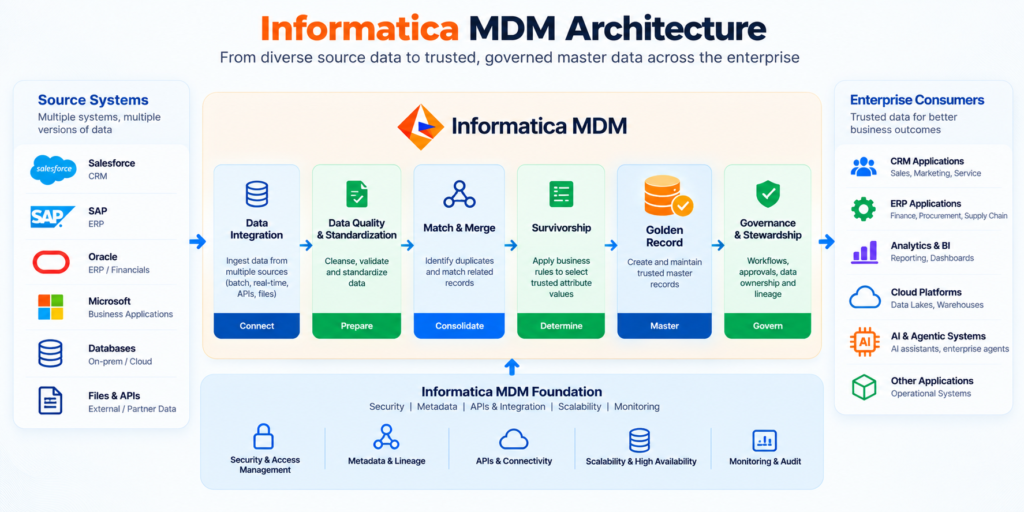
A useful way to understand Informatica MDM is as a data lifecycle rather than as a single repository.
Conceptually, the architecture looks like this:
Source Systems
↓
Data Integration & Ingestion
↓
Data Quality & Standardization
↓
Match & Merge
↓
Survivorship
↓
Trusted Master / Golden Record
↓
Hierarchy, Relationships & Governance
↓
APIs, Applications, Analytics & AI
Let’s look at each layer.
1. Source Systems
Master data usually begins in multiple operational systems.
Typical sources include:
- Salesforce and other CRM platforms
- SAP or other ERP systems
- Ecommerce applications
- Procurement platforms
- Billing systems
- Legacy databases
- Data warehouses
- Partner systems
- Flat files and external datasets
Informatica MDM SaaS supports the concept of source systems that provide records to the Business 360 datastore, including enterprise applications such as Salesforce and Workday.
Before implementing MDM, organizations therefore need to understand where master data currently originates and how each system uses it.
2. Data Integration and Ingestion
Once the source landscape is understood, relevant data has to move into the MDM process.
That may happen through:
- Batch ingestion
- APIs
- Cloud data integration
- Files
- Real-time integration
- Business events
This is where MDM quickly becomes an integration architecture problem as well as a data-management problem.
The quality of the master record depends on whether data from operational systems arrives reliably and whether mastered information can subsequently be published back to the systems that need it.
Current Informatica guidance explicitly treats both real-time and batch ingress and egress as important parts of an MDM SaaS architecture.
3. Data Quality and Standardization
Matching poor-quality data against poor-quality data will not magically create high-quality master data.
First, the information needs to be understood and standardized.
For example, suppose:
- Standardization of date formats
- Phone number verification
- Elimination of redundant punctuation
- Address normalization
- Handling irregular field formats
- Apply business validation rules.
Informatica can link data-quality rules to business entity fields, so incoming values can be cleaned, standardized and validated before or during the mastering process. This is an important step since quality and consistency of the compared attributes play a major role in successful matching.
4. Match and Merge
This is one of the core functions of MDM.
The system needs to determine whether records from multiple source systems represent:
- The same entity
- Potential duplicates requiring review
- Completely different entities
Matching models can use configurable rules, thresholds and other criteria to identify duplicate candidates.
Depending on the confidence level and business rules, the platform can:
Automatically merge high-confidence matches
Send uncertain matches for manual review
or
Leave unique records unchanged
Informatica’s current MDM SaaS guidance describes match-and-merge models in exactly this way: matching identifies duplicate candidates, and merge configuration determines whether records are automatically consolidated, routed for review or kept separate.
This is why match rules should not be treated as a one-time technical configuration.
They should be tested against real business data and refined with feedback from the people who understand that data.
5. Survivorship: Deciding Which Values Win
After records are identified as representing the same entity, another question appears:
Which values should survive into the master record?
Suppose two customer records contain different addresses.
Which one should become the trusted value?
A survivorship strategy may consider:
- Preferred source
- Recency
- Completeness
- Data-quality results
- Business-defined trust levels
Informatica’s MDM capabilities support survivorship rules and source ranking so organizations can determine how master-record values are selected from matching source records.
This is a critical implementation area because it converts business knowledge into repeatable data-management rules.
6. Hierarchies and Relationships
Enterprises do not operate as flat lists of customers, suppliers, or products.
Relationships matter.
For example:
Customer → Household
Account → Parent Company → Subsidiary
Supplier → Parent Supplier → Operating Entity
Product → Category → Brand
Understanding those relationships can change business decisions.
A sales team may discover that several accounts belong to the same corporate group.
A procurement team may identify supplier concentration risk.
A customer-service team may understand relationships between an individual and several business entities.
Informatica MDM supports hierarchy and relationship modelling for these types of scenarios.
7. Governance and Stewardship
Some decisions cannot—or should not—be fully automated.
Data stewards and business owners still play an important role when:
- Match confidence is uncertain
- Source systems conflict
- Data ownership needs clarification
- Exceptions require approval
- Sensitive attributes need controls
This is why MDM implementation is not purely an IT project.
It needs business ownership.
Someone must be responsible for defining what a “customer” means, deciding which system is authoritative for a field, approving matching rules, and determining how exceptions should be handled.
Without that operating model, even technically sound MDM implementations can struggle to deliver sustained value.
8. Distributing Trusted Master Data
Creating a golden record is useful only if the rest of the enterprise can use it.
Trusted master data may need to flow back into:
- CRM
- ERP
- Customer-service platforms
- Ecommerce
- Procurement
- Data warehouses
- Data lakes
- Analytics platforms
- AI and agent platforms
- Other enterprise applications
This completes the MDM loop.
Data enters from operational systems, becomes mastered and governed, and then returns to the enterprise as trusted information.
Why Informatica MDM Matters for Enterprise AI
This is where the MDM conversation is changing.
For years, organizations primarily justified MDM through:
Customer 360
Reporting accuracy
Operational efficiency
Regulatory compliance
ERP transformation
Those use cases remain important.
But AI introduces another requirement.
AI agents need context.
Imagine an AI service agent being asked:
“What is this customer’s account status, latest order, support history, and preferred contact method?”
If four systems contain conflicting versions of the customer, which one should the agent trust?
Giving AI faster access to fragmented data does not solve the problem.
It simply allows AI to make decisions using fragmented data faster.
Informatica’s current MDM positioning explicitly connects governed golden records with trusted AI context. Its latest messaging argues that messy, siloed data can lead to unreliable agents and that MDM provides a common trusted record for systems, teams and agents.
This makes MDM an important part of the larger architecture for enterprise AI readiness.
Key Business Benefits of Informatica MDM
A successful MDM program can support several business outcomes.
A More Reliable Customer 360
Unifying customer records can give sales, marketing and service teams a more complete picture of the people and organizations they serve.
Better Operational Decisions
Trusted supplier, customer and product data reduce ambiguity in workflows that depend on those entities.
Improved Data Quality
Survivorship, matching, validation, and standardization all help to minimize redundant and inconsistent data.
Stronger Analytics
Analytics becomes more reliable when reports are built around consistent entities and definitions.
Better Governance
Faster Digital Transformation
AI-Ready Context
Informatica MDM Implementation: What Enterprises Should Get Right
Buying an MDM platform is not the same thing as implementing an MDM strategy.
The implementation decisions determine whether the platform creates business value.
Start With the Business Outcome
Do not begin with:
“We need MDM.”
Begin with:
“Which business problem are we solving?”
Examples might include:
- Duplicate customer records affecting service
- Supplier duplication increasing procurement risk
- Product inconsistencies affecting ecommerce
- ERP modernization requiring common master data
- AI initiatives lacking trusted context
A clearly defined use case gives the MDM program something measurable to improve.
Start With One Domain
Trying to master every enterprise domain at once dramatically increases complexity.
A more practical approach is often:
Choose one high-value domain → establish the model → prove value → expand
For many organizations, that first domain may be customer, supplier, product, or reference data.
Profile the Data Before Designing Rules
Do not assume you already understand the condition of your data.
Profile it.
Identify:
- Duplication levels
- Missing attributes
- Source inconsistencies
- Invalid values
- Format differences
- Ownership issues
This evidence should influence data-quality, matching and survivorship design.
Involve Business Data Owners Early
Matching rules are not simply technical logic.
Survivorship is not simply an algorithm.
If business stakeholders are absent, the project risks producing technically clean data that the business does not actually trust.
Informatica’s own MDM discovery methodology emphasizes documenting business objectives, KPIs, stakeholders, source data, architectural needs and change-management requirements before implementation.
Design Integration Alongside MDM
Ask early:
How does data enter MDM?
How quickly must updates arrive?
Which systems consume mastered data?
Are APIs, events, batch integrations or combinations required?
How will downstream applications react when a master record changes?
MDM should not become an isolated data island.
Define Success Metrics
Useful MDM KPIs might include:
- Duplicate-record reduction
- Match accuracy
- Data completeness
- Data-quality scores
- Stewardship workload
- Time required to onboard a customer or supplier
- Reduction in manual reconciliation
- Adoption of mastered data by downstream systems
Those measures make it easier to move the MDM conversation from technology investment to business value.
The Bigger Picture: MDM Is Not Just About Creating One Record
The phrase “single source of truth” is often used when talking about MDM.
But the real value is broader.
The enterprise needs a mechanism for continuously determining what can be trusted as operational systems change.
New customers appear.
Addresses change.
Suppliers merge.
Products are introduced.
Systems are replaced.
AI applications create new data-consumption patterns.
MDM therefore should not be thought of as a one-time data-cleanup project.
It is an ongoing capability for maintaining trusted business context.
Why ProwessSoft for Informatica MDM
Successful MDM sits at the intersection of several disciplines:
Data + Integration + APIs + Governance + Applications + AI
That intersection is important.
A trusted master record has to be built from data that lives across enterprise applications. It must move reliably between those systems. It must be governed. And increasingly, it needs to support analytics and AI consumption.
As an Informatica partner, ProwessSoft is expanding its data-management capabilities around this ecosystem while bringing our existing experience in enterprise integration, APIs, cloud, data and AI.
Our Informatica MDM services can support organizations across areas such as:
- MDM discovery and readiness assessment
- Architecture and data-model design
- Source-system and integration assessment
- Customer, supplier and product mastering
- Data-quality rule design
- Match-and-merge strategy
- Survivorship and source-ranking design
- Hierarchy and relationship modelling
- Integration with CRM, ERP and cloud platforms
- Governance and stewardship design
- MDM modernization and cloud adoption
- MDM foundations for analytics and AI initiatives
The goal is not simply to implement another data platform.
It is to make trusted master data usable across the systems and business processes that depend on it.
Conclusion: Trusted Data Is Becoming Enterprise Infrastructure
For years, master data management was often treated as a data-quality initiative.
That definition is becoming too narrow.
When CRM, ERP, analytics, automation and AI all depend on the same customers, suppliers, products and business entities, master data becomes part of the enterprise’s operational foundation.
Informatica MDM provides a framework for consolidating those records, improving their quality, resolving duplicates, applying survivorship rules, managing relationships and distributing trusted master data back into the organization.
The technical architecture matters.
But successful MDM ultimately comes down to a business question:
Can every important system—and increasingly every AI agent—work from data the organization actually trusts?
If the answer is no, mastering that data is not simply an IT improvement.
It is a prerequisite for everything built on top of it.
Explore ProwessSoft's Informatica MDM Services
If your organization is dealing with fragmented customer, supplier, product or reference data—or preparing enterprise data for analytics and AI—ProwessSoft can help assess where MDM can create the most immediate value.
Explore ProwessSoft’s Informatica MDM Services
Start with your data landscape, business priorities and highest-value master-data domain.

Editor: Pranavi Dharma
Role: Marketing Associate
FAQs
Informatica MDM is a master data management capability that creates and maintains trusted master records across critical enterprise data domains, including customers, suppliers, products, locations, and reference data. Informatica’s current portfolio includes Customer 360, Supplier 360, Product 360, Reference 360, and multidomain MDM capabilities.
A golden record is the trusted master representation of an entity created after relevant source records are cleansed, standardized, matched, merged, and governed. Informatica also describes it as a master record or the best version of the truth for important business entities.
At a high level, Informatica MDM brings data from multiple source systems together, applies data-quality and standardization rules, identifies matching or duplicate records, applies merge and survivorship logic, creates trusted master records, manages relationships and hierarchies, and distributes mastered data to downstream systems.
A typical Informatica MDM architecture includes source systems, data integration, data quality, match and merge, survivorship, master records, hierarchy and relationship management, governance, and downstream consumption through APIs or integrations.
Current Informatica MDM SaaS assessments explicitly cover business-entity design, hierarchies, match models, survivorship, data-quality rules, APIs, workflows, and security.
Match and merge identifies records that may represent the same real-world entity and determines whether they should be consolidated into a trusted master record. Matching rules, confidence thresholds, and business criteria help determine whether records are automatically merged, reviewed, or retained separately.
Survivorship determines which attribute values should become part of the trusted master record when source systems contain conflicting information.
Rules may consider factors such as source-system priority, recency, completeness, data quality, or other business-defined trust criteria. Informatica’s MDM technical guidance explicitly includes survivorship configuration as part of MDM design.
The main benefits include more reliable customer and supplier information, fewer duplicates, improved data quality, stronger analytics, better governance, more consistent operational processes, and trusted data for downstream applications and AI.
For example, Informatica positions Customer 360 around creating a single trusted customer view, while Supplier 360 and Product 360 extend the same mastering principles to supplier and product information.
Common use cases include Customer 360, Supplier 360, Product 360, Reference Data Management, multidomain MDM, ERP transformation, CRM consolidation, data governance, analytics modernization, and AI readiness.
Informatica currently offers dedicated MDM applications for several of these domains.
Multidomain MDM manages more than one type of master-data domain within a common framework. For example, an organization may connect customer, supplier, product, material, and location data to understand relationships across the enterprise.
Informatica currently positions multidomain MDM as an all-in-one SaaS capability spanning multiple enterprise data domains.
Start with the business problem and highest-value master-data domain, then assess source systems, data quality, ownership, integration requirements, match logic, survivorship rules, governance, and measurable business outcomes.
Informatica’s own MDM discovery methodology emphasizes business objectives, requirements, implementation roadmaps, stakeholders, and change-management planning before implementation.