

Blog
MuleSoft Agent Fabric: The Missing Control Plane for the Agentic Enterprise
- September 10, 2026
- Anil Kumar Samayam
Introduction: Enterprise AI Is Entering Its Next Architecture Phase
For nearly two decades, connectivity has driven digital transformation.
Organizations connected applications through APIs.
They integrated systems to drop silos.
They unified data to create seamless customer experiences.
MuleSoft became one of the most influential platforms in this journey, helping enterprises transform disconnected applications into connected ecosystems.
Today, we stand at the beginning of another transformational shift:
The rise of autonomous AI agents.
Across industries, organizations are deploying intelligent agents capable of understanding context, reasoning over information, making decisions, and executing actions on behalf of users.
Sales teams are deploying opportunity intelligence agents.
Customer service organizations are launching support agents.
Finance teams are automating reconciliation processes.
Supply chain organizations are building inventory planning agents.
Human resources teams are introducing employee support assistants.
The promise is extraordinary.
But as AI moves from experimentation into enterprise-scale execution, a familiar architectural problem is beginning to appear.
Organizations are not simply adding more AI.
They are creating entire ecosystems of agents, models, tools, APIs, and platforms that must work together securely and predictably.
And without a common control layer, those ecosystems can quickly become fragmented.
That is where MuleSoft Agent Fabric becomes strategically important.
The Enterprise AI Problem Nobody Is Talking About
Most organizations believe their AI challenge is building agents.
In reality, their future challenge is managing them.
Consider a large enterprise.
Multiple business units independently deploy AI solutions.
Customer Service adopts Salesforce Agentforce.
Innovation teams experiment with OpenAI.
Cloud teams leverage Amazon Bedrock.
Business units deploy Microsoft Copilot Studio.
Data science groups use Google Vertex AI.
Initially, each implementation appears successful.
However, over time several challenges emerge:
- Duplicate agents solving similar problems
- Inconsistent governance models
- Uncontrolled LLM costs
- Security and compliance risks
- Limited visibility into agent activity
- Difficulty reusing existing AI capabilities
The result is an increasingly fragmented AI landscape where innovation accelerates but operational control decreases.
This is remarkably similar to what enterprises experienced during the early days of cloud adoption and API growth.
The lesson remains the same.
Organizations do not need fewer agents.
They need a better architecture for managing them.
This challenge is known as Agent Sprawl.
Agent Fabric was specifically designed to address this challenge by providing a unified control plane that can discover, govern, orchestrate, and observe agents across platforms.
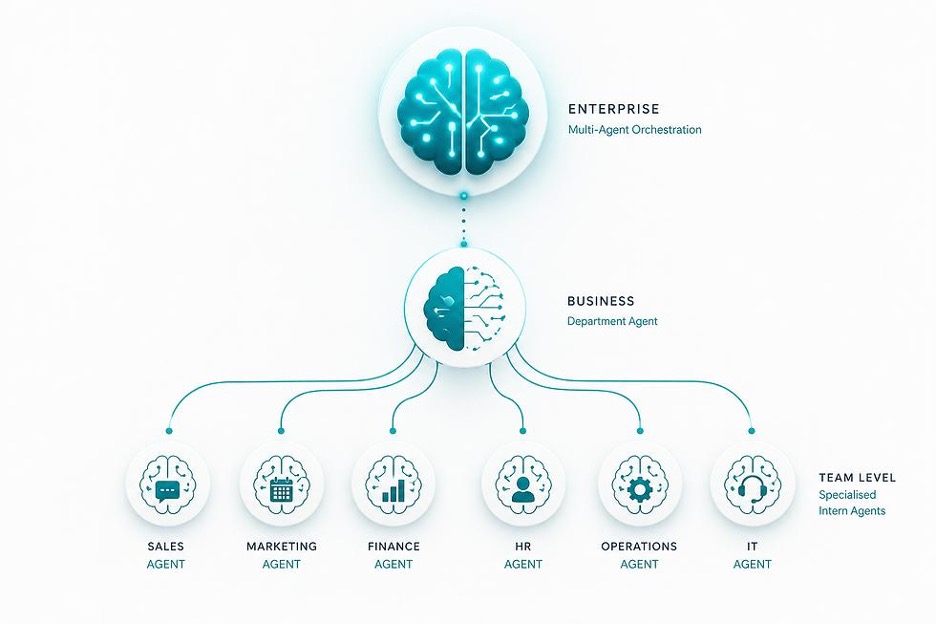
Introducing MuleSoft Agent Fabric
MuleSoft Agent Fabric is Salesforce’s answer to the growing complexity of enterprise AI.
At its core, Agent Fabric is an enterprise-wide control plane designed to manage the complete lifecycle of AI agents regardless of where they are built.
It is intentionally vendor-agnostic and supports environments such as:
- Salesforce Agentforce
- Amazon Bedrock
- Google Vertex AI
- Microsoft Copilot
- OpenAI-based agents
- Other AI ecosystems
Unlike traditional AI platforms focused primarily on creating agents, Agent Fabric focuses on coordinating and governing entire agent ecosystems.
Its purpose is simple:
Transform isolated AI initiatives into a connected digital workforce.
The Five Core Capabilities of Agent Fabric
Agent Fabric is built around five strategic capabilities.
1. Enterprise Actionability
Before agents can perform work, enterprise systems must become accessible to them.
Agent Fabric introduces Enterprise Actionability through MCP Bridge and MCP Connector capabilities, enabling existing APIs and enterprise assets to become agent-ready without requiring organizations to rebuild existing integrations.
Existing MuleSoft APIs can be exposed as MCP tools that agents can discover and use.
This means enterprises can extend the value of existing integration investments into the agentic world instead of rebuilding every business capability from scratch.
2. Discover
Organizations need visibility into all AI assets.
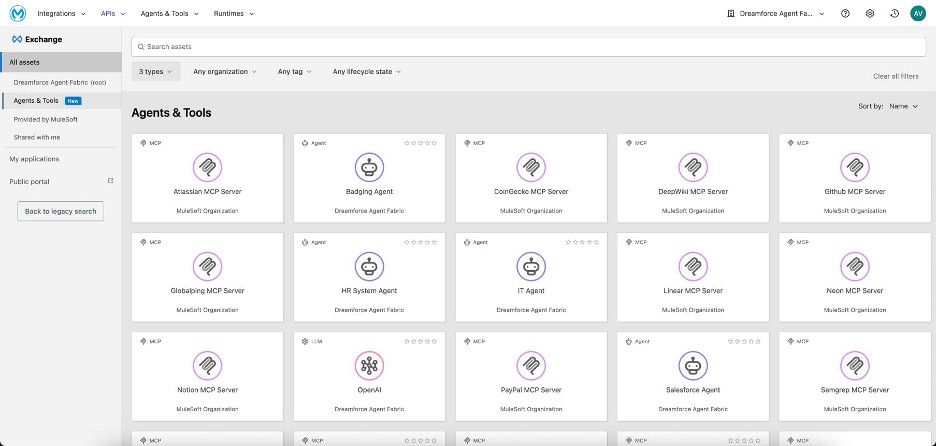
Agent Registry provides a centralized catalog where agents, MCP servers, APIs, models, and agentic assets can be discovered, managed, and reused across the enterprise.
Agent Scanners automatically discover assets from major ecosystems and register them in a unified portfolio.
This helps organizations answer fundamental questions such as:
- What agents already exist?
- What capabilities are available?
- Which assets can be reused?
- Where are duplicate solutions being created?
Discovery becomes the foundation for controlling agent sprawl.
3. Govern
Governance is often the difference between successful AI adoption and uncontrolled experimentation.
Agent Fabric introduces governance through:
- Omni Gateway
- Trusted Agent Identity
- Policy enforcement
- Security controls
- Cost management
- Compliance guardrails
These controls can be applied consistently across agent interactions.
As agent autonomy increases, governance becomes even more important because enterprises need to know not only what an agent can access, but also what it is permitted to do.
4. Orchestrate
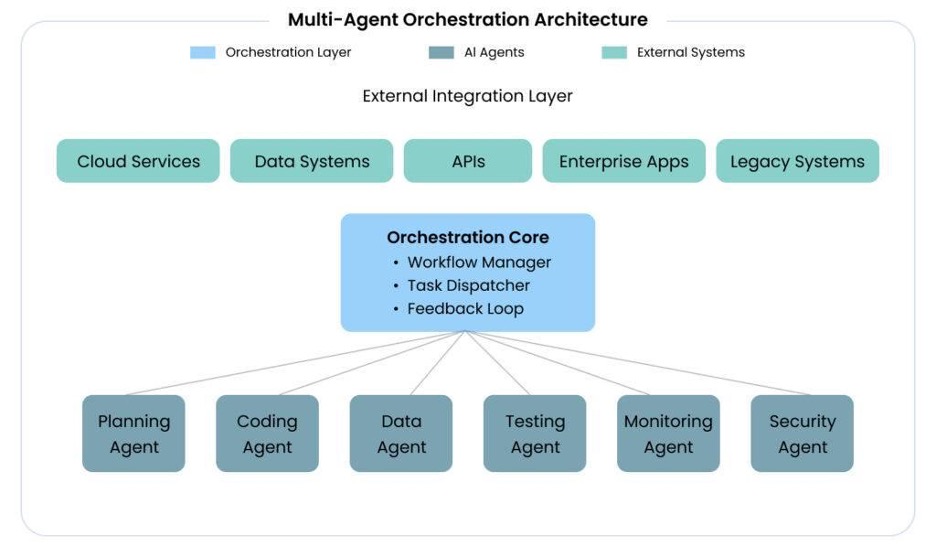
Enterprise business processes rarely depend on a single agent.
Agent Fabric introduces Agent Brokers capable of coordinating multiple agents and tools across ecosystems while ensuring predictable execution patterns through guided determinism.
Instead of forcing every AI capability into one large agent, enterprises can create specialized agents and allow the broker to coordinate them based on business context.
This enables a more modular and scalable agent architecture.
5. Observe
Enterprise AI cannot remain a black box.
Agent Visualizer provides end-to-end visibility into:
- Agent interactions
- Confidence scores
- Bottlenecks
- Hallucination risks
- Execution flows
- Operational metrics
Observability becomes essential when AI agents are making decisions and performing actions across enterprise systems.
Organizations need to understand not only whether an agent completed a task, but also how the interaction occurred and where issues emerged.
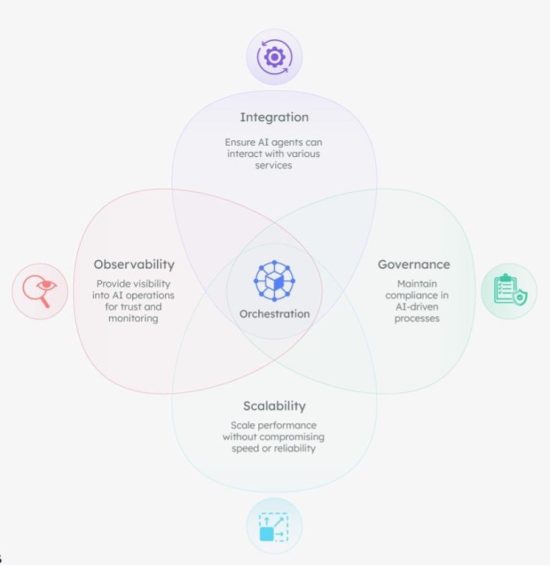
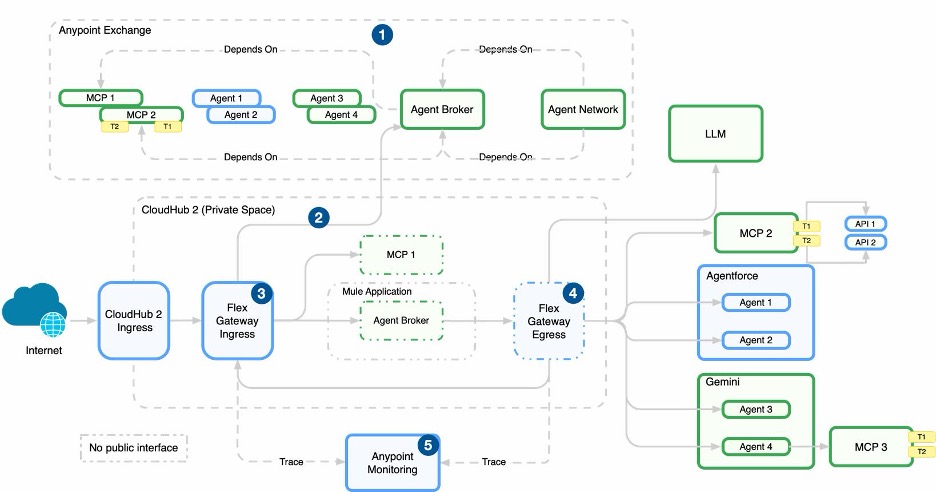
Understanding Agent Registry: The AI Equivalent of Anypoint Exchange
One of the most powerful innovations within Agent Fabric is Agent Registry.
For MuleSoft professionals, the easiest way to understand Agent Registry is to think of it as the next evolution of Anypoint Exchange.
Just as Exchange enables API discovery and reuse, Agent Registry enables organizations to discover and reuse:
- AI agents
- MCP servers
- Model proxies
- Agentic assets
across the enterprise.
This dramatically reduces duplication while accelerating innovation.
Instead of every team independently creating the same capabilities, organizations gain a shared portfolio of reusable agentic assets.
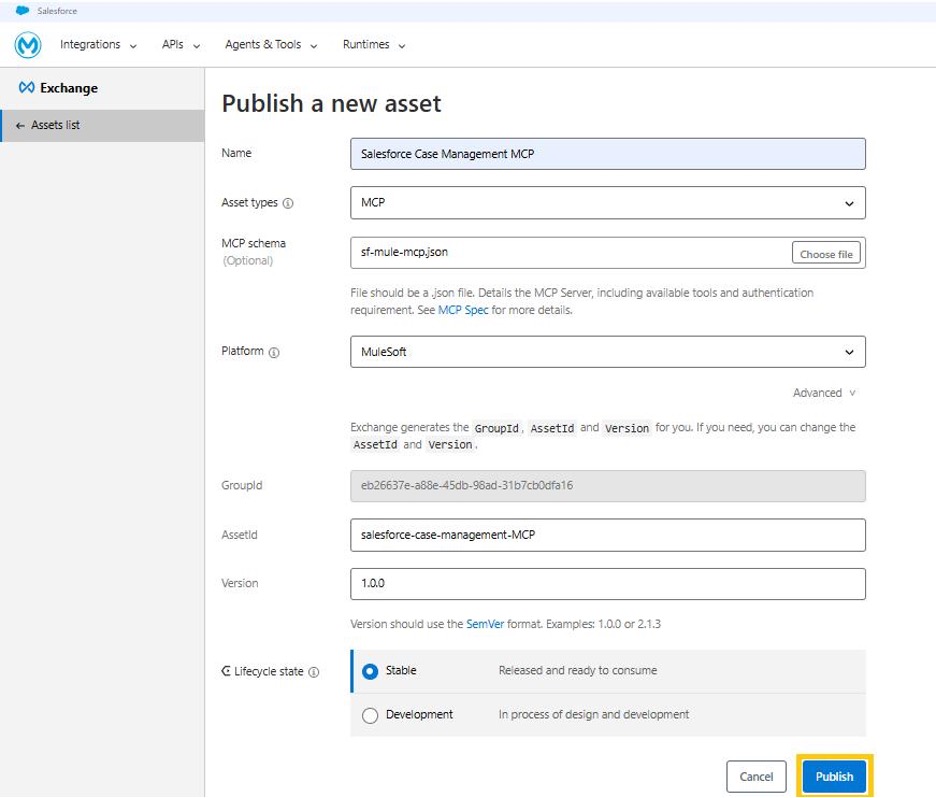
The Agent Broker is arguably the most important component of Agent Fabric.
Think of it as an intelligent orchestrator.
When a request enters the ecosystem, the broker evaluates:
- User intent
- Available agents
- Policies
- Context
- Runtime conditions
The broker then dynamically delegates tasks to the most appropriate agents within the network.
Agent Brokers are defined within Agent Networks and provide the orchestration intelligence that transforms isolated agents into a coordinated digital workforce.
This is the point where enterprise AI begins to move from individual agents toward agent collaboration.
MCP: The New API for the Agentic World
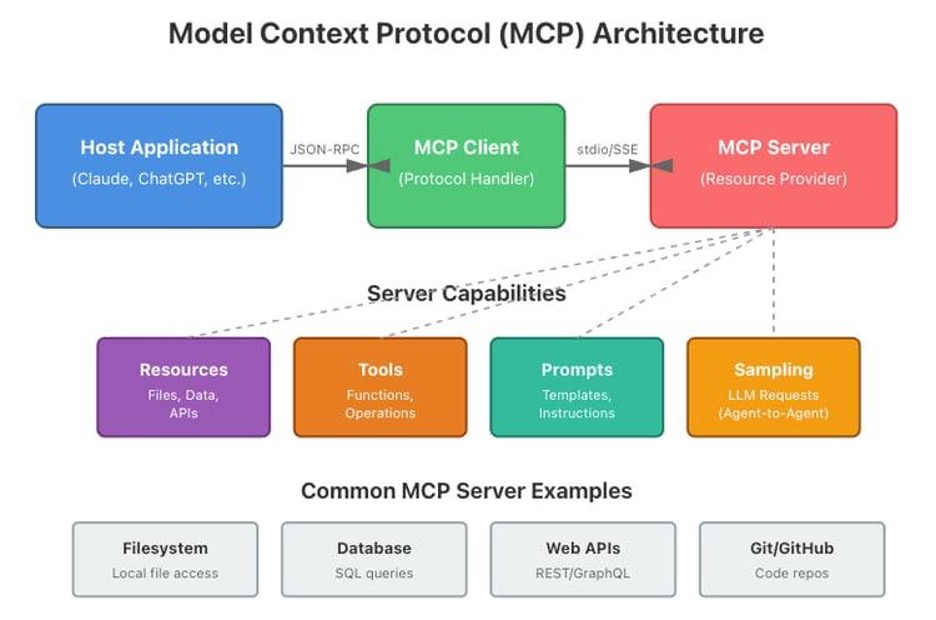
Just as REST became the universal language of application integration, Model Context Protocol (MCP) is emerging as a standard for agent interaction.
MCP enables agents to securely discover and access enterprise:
- Tools
- APIs
- Systems
- Capabilities
A useful analogy is:
APIs connected applications.
MCP connects intelligence.
Through MCP Bridge and MCP Connector, MuleSoft enables enterprises to expose existing business capabilities to AI agents without redesigning existing systems.
This is particularly important for organizations that have already invested heavily in API-led connectivity.
Rather than replacing their API foundation, they can make those capabilities accessible to agents through a governed agentic layer.
Real-World Implementation: Intelligent Order Resolution
Business Challenge
A global retail organization processes millions of customer orders every month.
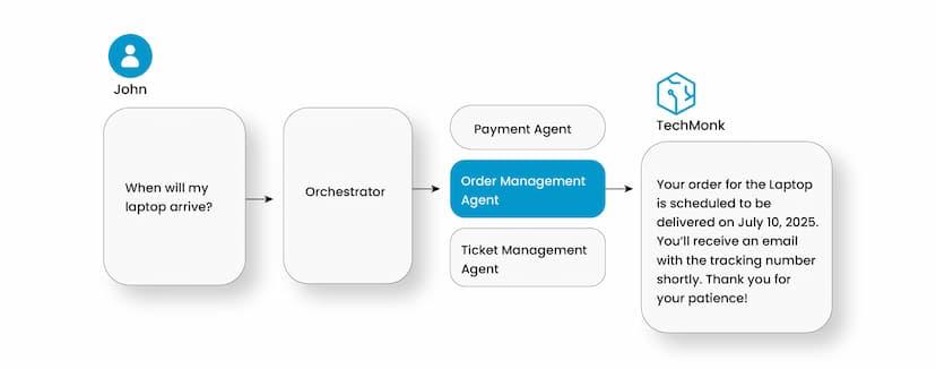
One of the most common support requests is:
“Where is my order?”
Answering this question requires data from multiple enterprise systems:
- Salesforce CRM
- SAP ERP
- Warehouse Management Systems
- Logistics Providers
- Customer Service Platforms
Historically, agents manually collected this information.
That process requires switching between systems, gathering multiple pieces of information, and then consolidating them before responding to the customer.
Agent Fabric Solution
Using Agent Fabric, a broker orchestrates multiple specialized agents:
- Customer Agent
- Order Agent
- Inventory Agent
- Shipping Agent
- Support Agent
Each agent retrieves information from its domain.
The broker aggregates results and returns a unified response.
Instead of requiring a single agent to understand every system, specialized agents can focus on specific business domains while the broker manages coordination.
Business Outcome
The implementation can deliver:
- 70–80% faster resolution times
- Reduced support costs
- Improved customer satisfaction
- Higher employee productivity
- Better visibility across systems
This use case proves how Agent Fabric can transform disconnected systems into intelligent business processes.
Successful Enterprise Use Cases for Agent Fabric
Banking
Loan processing agents collaborate with:
- Credit verification agents
- Compliance agents
- Fraud detection agents
This approach allows multiple specialized capabilities to participate in a single loan-processing workflow.
Healthcare
Patient scheduling agents coordinate with:
- Insurance verification
- Medical records agents
This creates a more connected workflow across administrative and clinical systems.
Manufacturing
Supply chain agents collaborate with:
- Procurement
- Inventory
- Logistics agents
This enables more intelligent coordination across the manufacturing value chain.
Telecommunications
Service agents coordinate across:
- Billing
- Network operations
- Customer support systems
These systems can help organizations resolve complex service requests that span multiple operational domains.
Insurance
Claims processing agents work alongside:
- Fraud detection
- Underwriting
- Policy validation agents
This technology creates an intelligent network of specialized agents around the claims lifecycle.
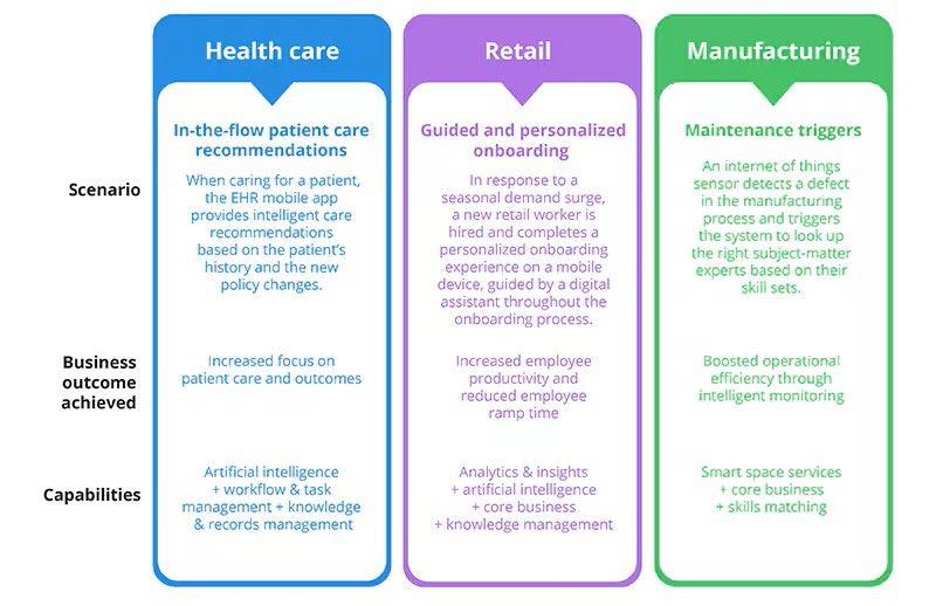
Why Agent Fabric Matters for Dreamforce 2026
Agent Fabric stands for one of the most significant innovations MuleSoft has introduced since the rise of API-led connectivity.
The conversation is no longer
“How do we build an AI agent?”
The conversation has evolved into:
“How do we govern and orchestrate thousands of AI agents across the enterprise?”
Agent Fabric answers that question.
Just as API-led connectivity transformed digital transformation, Agent Fabric is positioned to transform agentic transformation.
Organizations that master agent orchestration today will define the next generation of enterprise innovation.
Why This Shift Matters for Enterprise Architecture
The importance of Agent Fabric goes beyond introducing another AI product.
It signals a broader architectural shift.
During the API era, organizations had to solve challenges around:
- API discovery
- Reuse
- Security
- Governance
- Lifecycle management
- Observability
The agentic era introduces many of the same challenges at a new level.
Enterprises now need to manage:
- Agents
- Models
- MCP servers
- APIs
- Identity
- Policies
- Context
- Agent-to-agent communication
- Cost
- Observability
Without an architectural layer connecting these capabilities, AI adoption risks becoming fragmented.
Agent Fabric introduces that control layer.
It allows enterprises to move from simply deploying agents toward operating an agent ecosystem.
From Connected Systems to Connected Intelligence
Evolution can be summarized simply.
The API Era
Applications → APIs → Connected Systems
The aim was to make enterprise applications communicate reliably.
The Agentic Era
Agents → MCP → APIs → Enterprise Systems
The aim becomes enabling intelligence to discover, reason over, and act through those connected capabilities.
This does not make APIs less important.
It makes trusted, governed APIs even more valuable because agents need reliable capabilities through which they can interact with the enterprise.
The next generation of enterprise architecture therefore combines:
APIs + Data + Context + Agents + Governance
into a connected intelligence layer.
Why Prowess Software Services
Moving toward agentic architecture requires more than deploying AI agents.
The underlying enterprise integration foundation must be ready for agents to discover and use it securely.
That requires experience across:
- API-led connectivity
- MuleSoft architecture
- API management
- Enterprise integration
- Data foundations
- AI and automation
- Governance
- MCP-enabled architectures
At Prowess Software Services, our work across MuleSoft, APIs, data, automation, and AI positions us to help enterprises bridge the gap between their existing integration landscape and the emerging agentic enterprise.
Our approach starts with the foundation.
Conclusion: Orchestrating Intelligence Is the Next Enterprise Challenge
The future enterprise will not be powered by a single intelligent agent.
It will be powered by intelligent networks of specialized agents collaborating across systems, APIs, applications, and business processes.
That creates enormous opportunity—but it also creates a new management challenge.
As agent adoption accelerates, organizations will need a way to:
- Discover AI capabilities
- Govern agent access
- Coordinate specialized agents
- Connect agents to trusted enterprise systems
- Observe what agents are doing
- Reuse capabilities across teams
MuleSoft Agent Fabric provides the foundation for this vision by enabling organizations to discover, govern, orchestrate, and observe AI ecosystems at scale.
For enterprises already invested in API-led connectivity, this represents a natural evolution rather than a complete architectural reset.
The integration layer remains essential.
What changes is what sits above it.
APIs connected applications.
MCP connects intelligence.
Agent Fabric provides the control plane required to bring those capabilities together.
The future belongs to enterprises capable of orchestrating intelligence—not just deploying it.

Editor: Anil Kumar Samayam
10 FAQs
MuleSoft Agent Fabric is an enterprise control plane designed to help organizations discover, govern, orchestrate, and observe AI agents and agentic assets across platforms.
As organizations deploy more AI agents, they face agent sprawl, inconsistent governance, limited visibility, duplication, and security risks. Agent Fabric provides a centralized architecture to manage these challenges.
Its core capabilities include Enterprise Actionability, Discover, Govern, Orchestrate, and Observe.
Agent Registry is a centralized catalog for discovering and reusing AI agents, MCP servers, model proxies, APIs, and other agentic assets across the enterprise.
Agent Broker acts as an intelligent orchestrator that evaluates user intent, available agents, policies, context, and runtime conditions before delegating work across an agent network.
Model Context Protocol (MCP) allows AI agents to securely discover and access enterprise tools, APIs, and systems. MuleSoft uses MCP Bridge and MCP Connector capabilities to make existing enterprise assets agent-ready.
No. APIs remain the trusted enterprise connectivity layer. Agent Fabric builds on top of APIs by making them discoverable and usable by AI agents through governed agentic workflows.
Agent Fabric supports governance through capabilities such as Omni Gateway, Trusted Agent Identity, policy enforcement, security controls, cost management, and compliance guardrails.
Common use cases include intelligent order resolution, customer service, banking workflows, healthcare coordination, manufacturing operations, telecommunications, and insurance processes.
API-led connectivity connects applications and systems through reusable APIs, while Agent Fabric adds a control layer for coordinating, governing, and observing AI agents that use those enterprise capabilities.