

Blog
MuleSoft Agent Fabric: Building the Foundation for the Agentic Enterprise
- September 11, 2026
- Anil Kumar Samayam
Introduction: From Connected Enterprises to Agentic Enterprises
Every major shift in enterprise technology creates a new layer of complexity.
Cloud adoption created a need to connect rapidly expanding application landscapes. APIs helped solve that challenge by making enterprise capabilities accessible, reusable, and easier to govern. API-led connectivity then gave organizations a structured way to connect applications, data, and business processes at scale.
Enterprise AI is now creating the next architectural challenge.
Organizations are moving beyond isolated copilots and AI experiments toward autonomous agents capable of retrieving information, reasoning over context, making decisions, interacting with systems, and executing business actions.
The opportunity is significant. But as more teams deploy agents across customer service, sales, operations, finance, supply chain, and HR, enterprises face a critical question:
How do you manage hundreds—or eventually thousands—of agents operating across different platforms, systems, APIs, and business domains?
The next phase of AI adoption therefore is not simply about building more agents.
It is about creating the architecture required for those agents to discover capabilities, collaborate securely, operate within governance policies, and remain observable at enterprise scale.
That is the problem MuleSoft Agent Fabric is designed to address.
The Next Evolution of Enterprise Transformation
Every major technology shift introduces a new challenge.
When organizations embraced cloud computing, integration became the challenge. As businesses adopted hundreds of SaaS applications, connecting systems and ensuring data consistency became a strategic priority. The rise of APIs addressed that challenge and became the foundation of digital transformation.
Today, enterprises are entering another transformational era—the era of autonomous AI agents.
Across customer service, sales, operations, finance, supply chain, and human resources, organizations are deploying intelligent agents capable of reasoning, making decisions, retrieving information, and executing actions independently. These agents promise to accelerate productivity, improve customer experiences, and unlock entirely new business capabilities.
However, as organizations expand AI adoption, they quickly encounter a familiar problem: complexity.
The challenge is no longer building agents.
The challenge is managing an ecosystem of agents operating across multiple platforms, systems, and business domains.
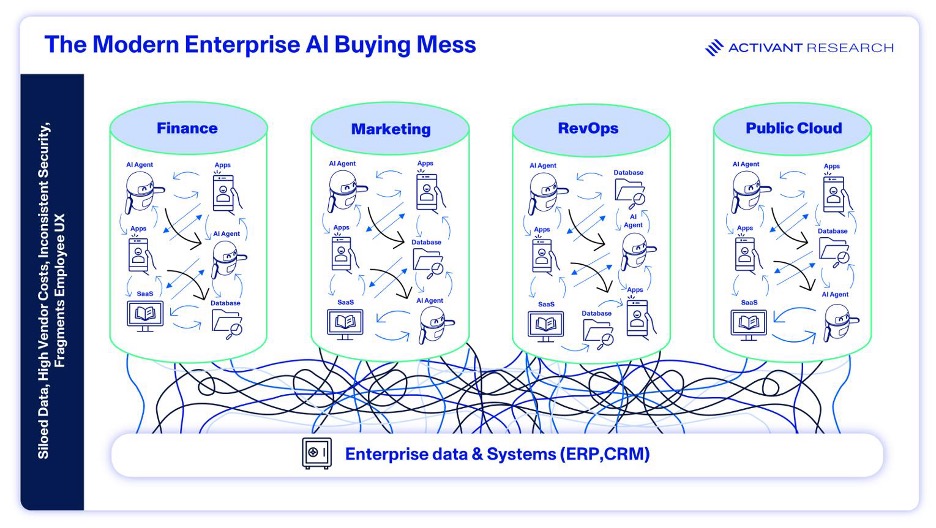
This emerging challenge is known as Agent Sprawl.
Understanding Agent Sprawl
Most organizations are not building a single AI agent.
Customer service teams create support agents.
Sales teams deploy account intelligence assistants.
Supply chain organizations develop forecasting agents.
Finance teams automate reconciliation and reporting processes.
HR departments implement employee support agents.
Each initiative delivers measurable value. Yet as adoption accelerates, enterprises often discover they have unintentionally created a fragmented AI landscape.
Business leaders begin asking important questions:
- How many agents exist across the organization?
- Which systems and data sources are they accessing?
- How are security policies being enforced?
- Are multiple teams building similar capabilities?
- How can agents collaborate to solve complex business problems?
Without a centralized strategy, enterprises face increased costs, inconsistent governance, compliance concerns, and limited visibility into AI operations.
This is precisely the challenge MuleSoft Agent Fabric was designed to solve.
Introducing MuleSoft Agent Fabric
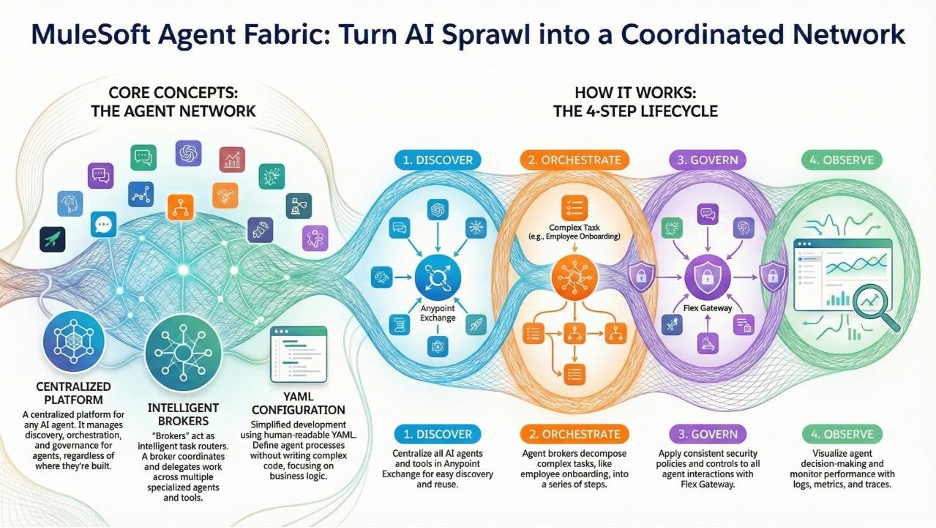
MuleSoft Agent Fabric is an enterprise-wide orchestration and governance framework designed to help organizations discover, govern, orchestrate, and observe AI agents regardless of where they are built.
Rather than replacing existing AI investments, Agent Fabric acts as a unifying layer across Salesforce Agentforce, OpenAI, Amazon Bedrock, Microsoft Copilot Studio, Google Vertex AI, and custom-built agents.
At its core, Agent Fabric enables enterprises to:
- Discover reusable AI capabilities
- Govern agent interactions
- Orchestrate collaboration across multiple agents
- Observe and monitor agent behavior
- Scale AI initiatives securely
Think of Agent Fabric as the enterprise control plane for the agentic world.
Just as APIs became the backbone of digital transformation, Agent Fabric is becoming the backbone of agentic transformation.
The Four Pillars of Agent Fabric
1. Discover
Organizations need visibility into their AI ecosystem.
Agent Fabric enables teams to discover and catalog:
- Agents
- MCP servers
- APIs
- Models
- Reusable enterprise assets
This promotes reuse and prevents duplicate development efforts.
2. Govern
Governance is one of the most critical requirements for enterprise AI.
Agent Fabric provides:
- Security policies
- Access controls
- Identity management
- Compliance enforcement
- Data protection
- Cost management
This ensures AI operates within enterprise guardrails.
3. Orchestrate
Enterprise business processes rarely depend on a single agent.
Agent Fabric introduces Agent Brokers that coordinate multiple specialized agents and intelligently route requests across the ecosystem.
4. Observe
AI cannot be a black box.
Agent Fabric provides observability into:
- Agent interactions
- Execution flows
- Performance metrics
- Costs
- Errors
- Operational health
This enables organizations to continuously optimize AI operations.
Core Components of Agent Fabric
Agent Registry
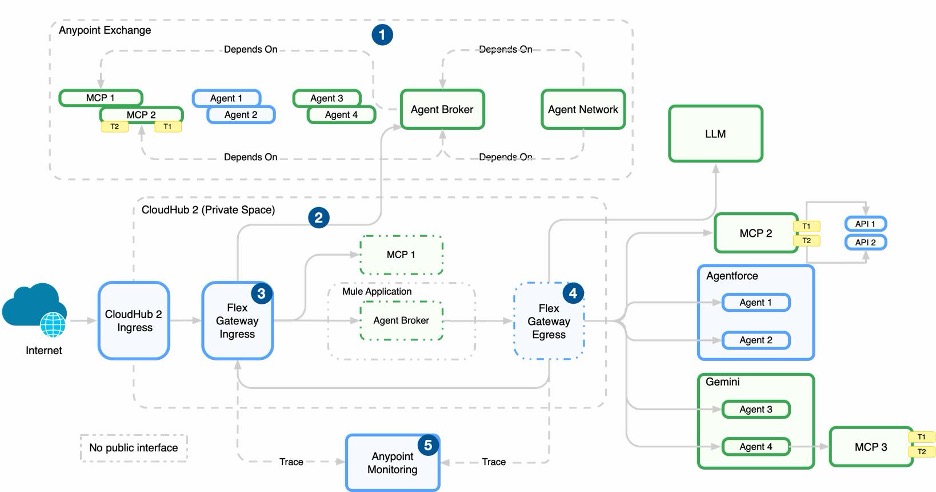
Agent Registry serves as a centralized catalog where organizations can register, discover, and manage agents.
It provides visibility into existing capabilities and helps teams identify opportunities for reuse before creating new solutions.
Agent Broker
Agent Broker acts as the intelligent coordinator within the ecosystem.
It determines:
- Which agent should handle a request
- Which agents should collaborate
- How tasks should be distributed
- How responses should be aggregated
This enables seamless multi-agent execution.
MCP Integration
Model Context Protocol (MCP) provides a standardized mechanism for agents to securely access enterprise tools, APIs, and systems.
MCP helps reduce integration complexity while maintaining security and governance.
Agent Networks
Agent Networks enable organizations to create collaborative ecosystems where specialized agents work together to achieve business outcomes.
Instead of relying on a single agent, enterprises can leverage domain-specific expertise across multiple agents.
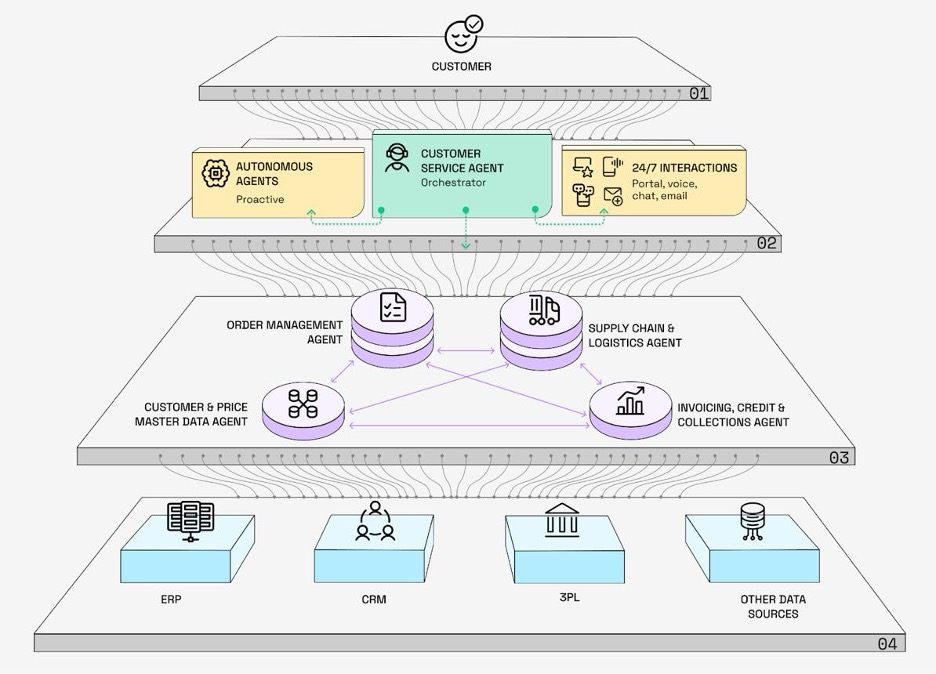
Real-World Use Case: Intelligent Order Resolution

Consider a global retail organization processing millions of customer orders each month.
A customer contacts support and asks a simple question:
“Where is my order?”
Although the question appears straightforward, answering it often requires information from multiple enterprise systems.
- Customer information resides in Salesforce.
- Order details are stored in SAP.
- Inventory data comes from warehouse systems.
- Shipping information is provided by logistics partners.
- Support history exists within customer service platforms.
Traditionally, a support representative manually accesses each system before providing a response.
With Agent Fabric, the process becomes intelligent and automated.
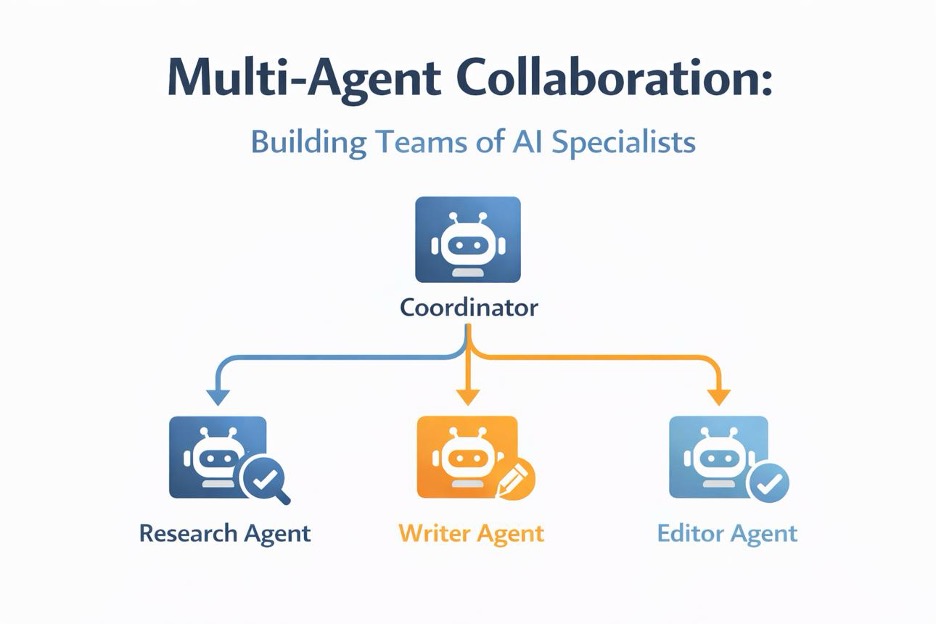
An Agent Broker receives the request and coordinates multiple specialized agents simultaneously:
- Customer Agent retrieves customer details.
- Order Agent validates purchase information.
- Inventory Agent checks stock availability.
- Shipping Agent retrieves logistics status.
- Support Agent compiles the final response.
The customer receives a complete and accurate answer within seconds.
The result is:
- Faster resolution times
- Improved customer satisfaction
- Lower operational costs
- Increased employee productivity
The example illustrates the central architectural shift: instead of forcing one agent to handle every capability, specialized agents can work together across enterprise systems.
Agent-to-Agent Collaboration: The Future of Enterprise AI
One of the most innovative capabilities of Agent Fabric is Agent-to-Agent (A2A) communication.
In traditional architectures, applications communicate through APIs.
In agentic architectures, agents communicate with other agents.
For example:
A Customer Service Agent can request information from an Order Agent.
The Order Agent can collaborate with a Supply Chain Agent.
The Supply Chain Agent can retrieve shipment details from a Logistics Agent.
Through Agent Fabric, these interactions remain secure, observable, and governed.
This creates an intelligent digital workforce capable of solving increasingly complex business problems.
Building Agent Networks with MuleSoft
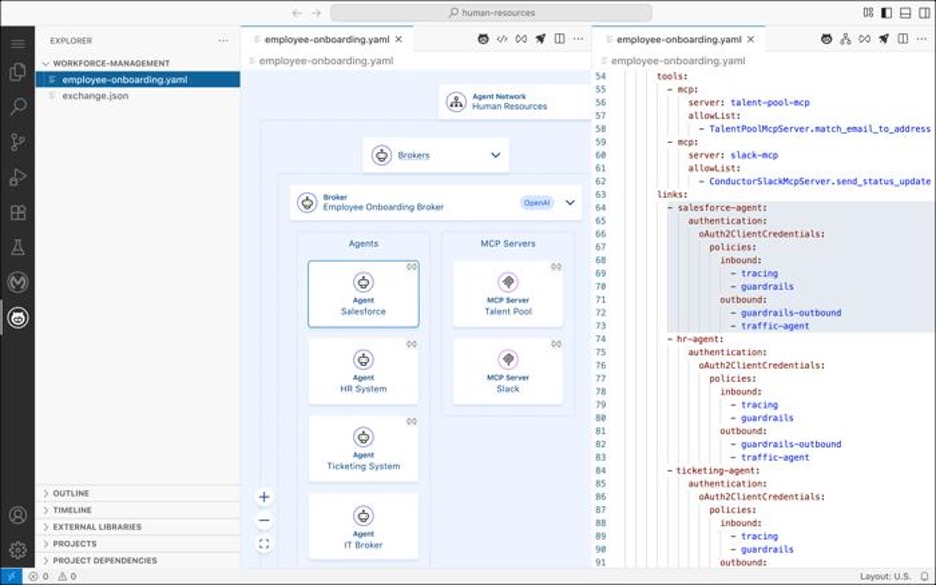
Using Anypoint Platform and Anypoint Code Builder, developers can define:
- Agent Networks
- Agent Brokers
- Agent Relationships
- MCP Servers
- API Integrations
- Governance Policies
These solutions can then be deployed through CloudHub 2.0 or Runtime Fabric environments while leveraging existing MuleSoft security, monitoring, and governance capabilities.
This allows organizations to accelerate AI adoption while protecting existing technology investments.
Business Benefits of Agent Fabric
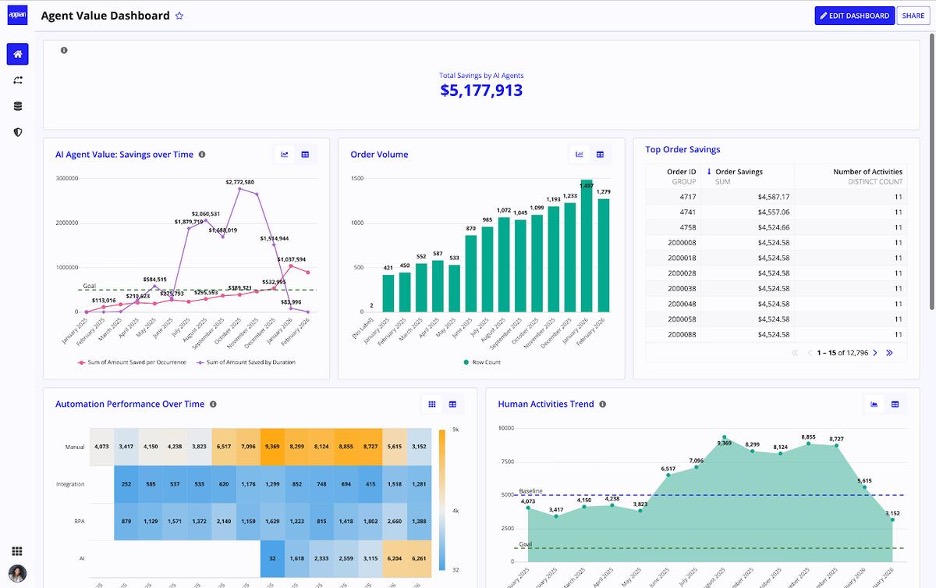
Faster Time-to-Value
Reuse existing agents, APIs, and enterprise assets rather than building solutions from scratch.
Improved Governance
Apply consistent security, compliance, and operational policies across all agent interactions.
Better Customer Experiences
Deliver faster and more accurate responses through multi-agent collaboration.
Reduced Operational Expenses
Automate complex workflows and reduce manual effort.
Future-Ready Architecture
Create a scalable foundation capable of supporting thousands of agents across the enterprise.
The Future of the Agentic Enterprise
The future enterprise will not be powered by a single intelligent assistant.
It will be powered by networks of specialized agents collaborating across customer service, sales, finance, operations, supply chain, and human resources.
Organizations that can effectively discover, govern, orchestrate, and observe these agent ecosystems will gain a significant competitive advantage.
MuleSoft Agent Fabric provides the foundation required to make that vision a reality.
Why Prowess Software Services
Implementing Agent Fabric is not simply an AI initiative.
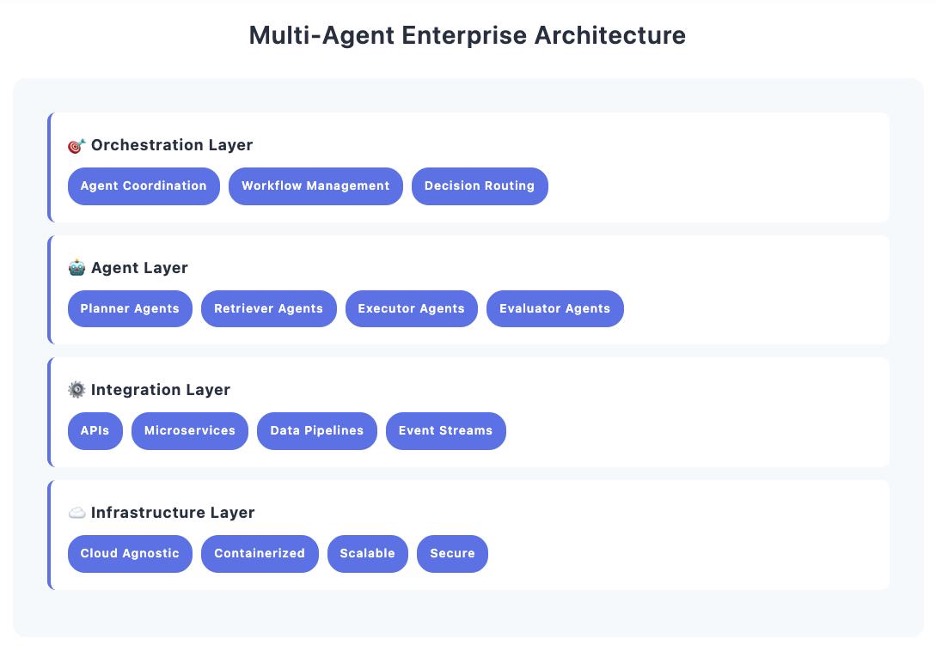
It requires organizations to connect three architectural layers effectively:
AI agents → APIs and integration → enterprise systems and data
That is where deep integration expertise becomes important.
At Prowess Software Services, we help enterprises evolve their existing integration foundations for the agentic era—from API-led connectivity and MuleSoft architecture to agent-ready APIs, MCP-enabled capabilities, governance, and intelligent orchestration.
Our approach focuses on practical enterprise questions:
Are your APIs agent-ready?
Enterprise capabilities need to be discoverable, reusable, secure, and governed before agents can reliably act through them.
Can agents access the right enterprise context?
AI requires trusted access to CRM, ERP, data platforms, operational applications, and business processes.
How will agent interactions be governed?
Identity, policies, access controls, security, observability, and cost management need to be designed into the architecture.
Can existing MuleSoft investments be reused?
The objective should be to extend existing APIs and integration assets into the agentic ecosystem—not unnecessarily rebuild them.
How do you move from isolated agents to agent networks?
Agent Registry, Agent Broker, MCP integration, and Agent Networks create the foundation for governed multi-agent collaboration.
For enterprises evaluating MuleSoft Agent Fabric, the starting point is therefore not simply “Which agent should we build?”
A better question is:
“Is our enterprise architecture ready for agents to discover, access, and act across it securely?”
This is where Prowess brings together MuleSoft, APIs, data, automation, and AI to help organizations move from connected systems toward connected intelligence.
Conclusion: Building the Foundation for Connected Intelligence
The next generation of enterprise transformation will not center on individual AI agents.
It will be defined by how effectively organizations connect, govern, orchestrate, and see those agents.
As AI adoption expands, enterprises will need to move beyond isolated implementations and set up an operating model for managing agent ecosystems across platforms, applications, APIs, data, and business processes.
MuleSoft Agent Fabric provides the control plane for that transition—bringing together Agent Registry, Agent Broker, MCP integration, Agent Networks, governance, and observability to create a more connected and manageable agentic architecture.
For organizations already invested in MuleSoft and API-led connectivity, this upgrade is also, an important evolution of the integration landscape.
The APIs that connect enterprise applications can now become capabilities that intelligent agents discover and use.
The systems that power digital transformation can become the foundation for agentic transformation.
And the organizations that prove the right architecture now will be better positioned to scale AI without allowing innovation to outpace governance.
The future is not a single intelligent agent. The future is an intelligent network of agents working together to deliver meaningful business outcomes.

Editor: Anil Kumar Samayam
10 FAQs
MuleSoft Agent Fabric is an enterprise-wide orchestration and governance framework that helps organizations discover, govern, orchestrate, and observe AI agents across platforms, systems, and business domains.
Agent Fabric addresses Agent Sprawl—the fragmentation that occurs as enterprises deploy multiple AI agents across different teams and platforms, creating challenges around governance, duplication, security, compliance, and visibility.
The four pillars are Discover, Govern, Orchestrate, and Observe. They help organizations catalog AI assets, enforce policies, coordinate multiple agents, and monitor agent operations.
Agent Registry is a centralized catalog where organizations can register, discover, and manage agents. It improves visibility into existing capabilities and helps teams reuse assets instead of creating duplicate solutions.
Agent Broker is the intelligent coordinator that determines which agent should handle a request, which agents need to collaborate, how tasks should be distributed, and how responses should be aggregated.
Model Context Protocol (MCP) provides a standardized mechanism for AI agents to securely access enterprise tools, APIs, and systems while helping maintain security and governance.
Agent Networks enable multiple specialized AI agents to collaborate toward a business outcome rather than relying on a single agent to perform every task.
Agent Fabric enables agents to communicate and collaborate across business domains. For example, a Customer Service Agent can work with Order, Supply Chain, and Logistics Agents while interactions remain secure, observable, and governed.
The blog identifies faster time-to-value, improved governance, better customer experiences, reduced operational costs, and a future-ready architecture as key benefits of adopting Agent Fabric.
Enterprises should evaluate whether their APIs and systems are ready for agent access, establish governance and security controls, make enterprise capabilities discoverable, and design architectures that support collaboration between specialized agents. This builds on Agent Fabric’s core model of connecting agents, APIs, systems, and data within a governed ecosystem.