

Blog
MuleSoft Agent Fabric vs. Traditional MuleSoft: The Future of Autonomous Order Processing
- September 09, 2026
- Hari Krishna Kasetty
Introduction: Enterprise Integration Is Moving Beyond Connectivity
Consider a typical enterprise order.
A customer places an order. The business needs to confirm the customer and payment, check inventory, reserve stock, coordinate with a third-party organization provider, arrange shipping, update multiple systems, and keep the customer informed.
MuleSoft’s API-led approach provides a structured and reliable way to connect these systems and orchestrate the process.
However, the difference between MuleSoft Agent Fabric vs API-Led Integration becomes more relevant when the workflow needs to respond dynamically to changing conditions rather than simply follow a predefined sequence.
But what happens when inventory is unavailable? Is a logistics provider delayed? A payment fails? Or the business needs to choose between several possible next actions?
Traditional integration can manage these situations when the rules and exception paths have already been defined. More dynamic scenarios often require additional logic or human intervention.
This is where MuleSoft Agent Fabric introduces a different architectural model: AI-driven orchestration.
Rather than replacing APIs, agents can use governed enterprise capabilities to interpret context, determine appropriate actions, and coordinate work across systems.
The shift is therefore not simply from APIs to AI.
It is from predefined orchestration to context-aware orchestration built on top of trusted enterprise connectivity.
The Scenario: Customer Order Processing
Consider the following workflow:
Customer places an order → Inventory is validated → Fulfilment is coordinated → Shipping is arranged → Delivery is confirmed
Both traditional API-led integration and agentic orchestration can support this process.
The difference is primarily in how decisions and exceptions are handled.
Approach 1: API-Led MuleSoft Orchestration
What Is API-Led Orchestration?
MuleSoft’s API-led connectivity model organizes enterprise capabilities through reusable Experience, Process, and System APIs.
For an order-processing scenario, APIs can reliably connect customer databases, payment services, ERP platforms, inventory systems, logistics providers, and shipping applications.
A simplified architecture could look like this:
Customer Order
↓
Order Validation
→ Check Customer
→ Validate Payment
→ Verify Inventory
↓
Fulfilment
→ Reserve Stock in ERP
→ Create Purchase Order
→ Call 3PL Service
↓
Shipping
→ Generate Shipping Label
→ Update Systems
→ Notify Customer
→ Log Transaction
This approach works extremely well when business processes and decision paths are known in advance.
The challenge appears when reality does not follow the expected path.
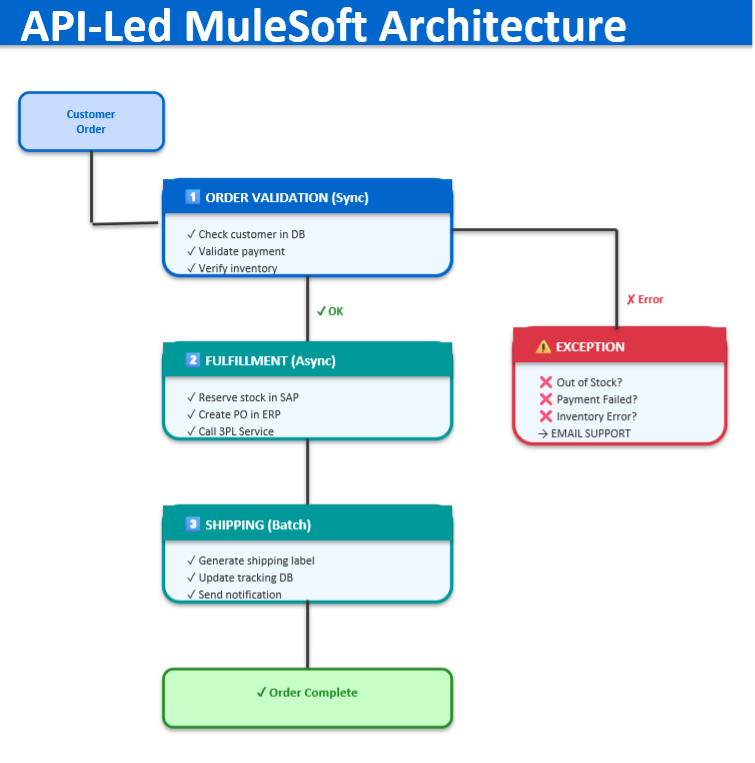
For example:
Inventory unavailable?
Follow the predefined exception flow.
3PL unavailable?
Trigger an alternative process or escalate.
Payment unsuccessful?
Execute configured retry or exception logic.
Every alternative generally needs to be anticipated and designed into the integration.
Where Traditional Orchestration Becomes Complex
As the number of systems, dependencies, and exceptions increases, integration logic can become increasingly sophisticated.
Teams may need to manage:
- Multiple conditional paths
- Exception handling
- Retry mechanisms
- Human escalations
- System-specific business rules
- Monitoring and operational intervention
This is not a weakness of API-led connectivity. APIs remain essential for reliable enterprise integration.
The limitation is that traditional orchestration primarily executes logic that has already been defined.
It does not inherently reason about a new situation and decide what should happen next.
What Changes with Agentic Orchestration?
MuleSoft Agent Fabric introduces an agent-oriented approach in which AI agents can participate in enterprise processes while operating through governed systems, APIs, and policies.
Instead of only asking:
“Which predefined flow should execute?”
an agentic architecture can evaluate:
“Given the current context, constraints, policies, and available enterprise capabilities, what is the appropriate next action?”
That distinction matters.
APIs continue to provide reliable access to enterprise capabilities.
Agents introduce a reasoning and coordination layer above those capabilities.
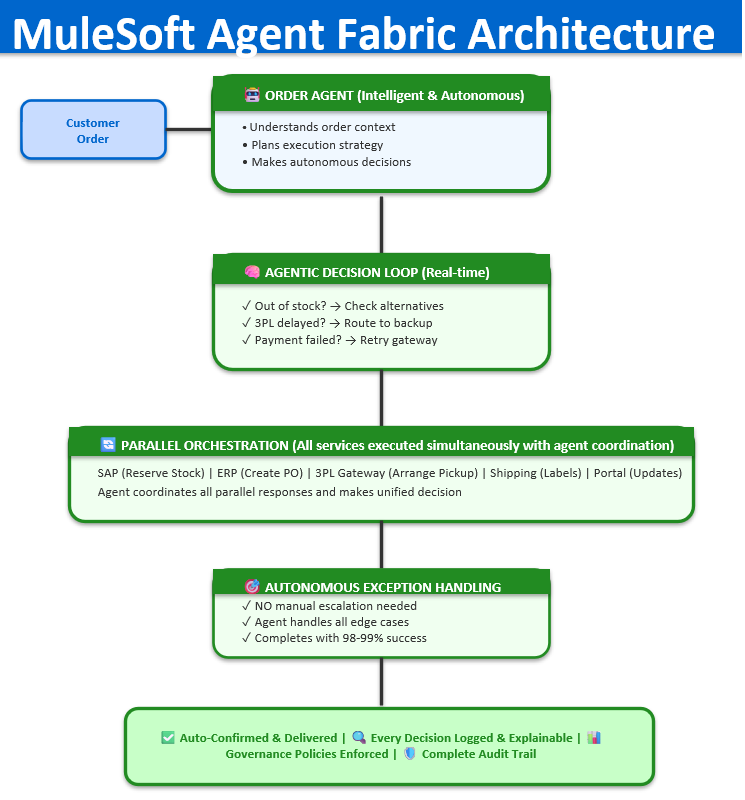
How Agentic Order Processing Could Work
Consider the same customer order:
Customer Order
↓
Order Agent
↓
Interpret Context
→ Determine order priority
→ Identify dependencies
→ Evaluate constraints
↓
Determine Next Actions
→ Check inventory
→ Evaluate fulfilment options
→ Coordinate logistics
→ Respond to exceptions
↓
Execute Through Governed APIs
→ ERP
→ Inventory
→ 3PL
→ Shipping Platform
→ Customer Portal
↓
Monitor Outcome and Escalate When Required
Instead of creating a rigid path for every possible scenario, the agent can potentially select among approved actions based on the context available to it.
Example: When Inventory Is Unavailable
This illustrates the architectural difference clearly.
Traditional API-Led Flow
Inventory check fails.
The integration follows whatever exception path has been explicitly configured—for example:
Out of Stock → Notify Support → Manual Decision
A more sophisticated integration could certainly automate alternatives, but those rules would need to be designed beforehand.
Agentic Flow
An appropriately governed order agent could evaluate approved alternatives such as:
- Check another warehouse.
- Determine whether alternative inventory is available.
- Evaluate another approved fulfilment route.
- Check the customer’s delivery commitment.
- Select an allowed action based on business policy.
- Escalate to a human when the situation exceeds its authority.
The difference is not that APIs disappear.
The agent is reasoning across API-enabled capabilities.
Autonomous Exception Handling
Exception handling is one of the areas where agentic integration has significant potential.
Consider three common scenarios.
Out of Stock
Instead of immediately escalating the order, an agent could check approved alternative fulfilment locations.
Logistics Delay
The agent could evaluate available logistics options and determine whether another approved provider satisfies the delivery requirement.
Payment Exception
The agent could follow permitted retry or recovery procedures and escalate when policy requires human approval.
The objective should not be “zero humans.”
The more practical enterprise objective is:
Automate routine decisions while preserving human control over high-risk, ambiguous, or policy-sensitive decisions.
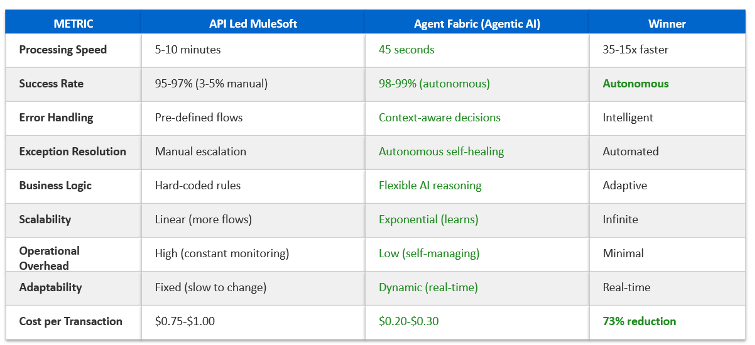
The Paradigm Shift: API Orchestration vs. AI Orchestration
API-led and agentic integration should not be viewed as competing architectures.
They solve different layers of the problem.
- Connects systems
- Executes predefined logic
- Uses deterministic workflows
- Handles known exceptions through configured paths
- APIs expose capabilities
- Humans manage complex exceptions
- Coordinates capabilities intelligently
- Reasons within defined boundaries
- Supports context-aware decisions
- Can evaluate approved alternatives dynamically
- Agents discover and use capabilities
- Humans supervise higher-risk decisions
The evolution can therefore be described simply:
API-Led: Can our systems communicate reliably?
Agentic: Can AI coordinate those capabilities intelligently and safely?
APIs Still Matter in the Agentic Enterprise
Agent Fabric does not make API-led architecture obsolete.
In fact, autonomous agents increase the importance of well-designed enterprise APIs.
An agent still needs secure, reliable capabilities for actions such as:
- Checking inventory
- Reserving stock
- Updating an order
- Processing an approved transaction
- Retrieving customer information
- Arranging fulfilment
- Sending notifications
Without well-governed APIs, agents have no reliable enterprise action layer.
The future architecture therefore looks less like:
APIs → replaced by Agents
and more like:
Enterprise Systems → APIs → Governance → Agents → Business Outcomes
APIs provide the capabilities.
Agents determine how those capabilities should be coordinated within the permissions and policies assigned to them.
Governance Becomes More Important, Not Less
Giving AI agents access to enterprise actions introduces a new set of questions.
Organizations need to determine:
- Which systems can an agent access?
- Which actions can it execute?
- Under whose identity?
- Which decisions require approval?
- How are agent actions logged?
- How can decisions be traced?
- What happens when confidence is low?
- When should a human take control?
This makes identity, policy enforcement, observability, auditability, and human oversight fundamental components of agentic architecture.
Autonomy without governance creates risk.
Governed autonomy creates enterprise value.
Where Agent Fabric Can Create Value
The order-processing example is only one potential application.
The same architectural pattern can apply to:
Order Processing
Coordinate validation, inventory, fulfilment, shipping, and exceptions.
Customer Service
Allow agents to retrieve enterprise context and execute approved actions without repeatedly transferring customers between teams.
Supply Chain Operations
Evaluate inventory, logistics, supplier, and delivery information to coordinate responses to changing conditions.
Invoice Management
Support reconciliation, exception investigation, and approved follow-up actions.
Compliance Operations
Evaluate information against defined policies while preserving decision and action histories.
Predictive Operations
Combine operational signals with enterprise actions to respond proactively to emerging issues.
What Changes for Integration Teams?
For integration architects, the move toward agentic systems changes the design question.
Previously, teams primarily asked:
“What integrations and flows do we need to build?”
Increasingly, they will also need to ask:
“Which enterprise capabilities should agents be allowed to discover and use?”
That means integration teams will need to think beyond connectivity and consider:
- Agent-ready APIs
- Capability discovery
- Identity
- Authorization
- Policy
- Context
- Observability
- Human-in-the-loop controls
The integration layer becomes part of the enterprise AI operating model.
Conclusion: From Connected Systems to Intelligent Coordination
Traditional MuleSoft integration remains a powerful foundation for connecting enterprise systems and automating predictable business processes.
MuleSoft Agent Fabric introduces the possibility of adding another layer: intelligent coordination across those connected capabilities.
The transition is:
From predefined workflows → context-aware orchestration
From manual exception handling → governed AI-assisted resolution
From APIs as integration endpoints → APIs as capabilities agents can securely use
The future of enterprise integration is therefore unlikely to be about choosing between APIs and agents.
It will be about combining them effectively.
APIs provide trusted enterprise capabilities. Agents provide reasoning and coordination. Governance determines what they are allowed to do.
That combination is what can move enterprises from connected systems toward genuinely agentic operations.
How Prowess Software Services Helps
At Prowess Software Services, we help enterprises prepare integration landscapes for the next generation of AI-driven operations.
Our approach focuses on connecting the layers that matter:
APIs → Integration → Enterprise Context → Governance → AI Agents
From API modernization and MuleSoft integration to agent-ready architecture and AI orchestration, we help organizations build foundations where intelligent agents can interact with enterprise capabilities securely, reliably, and at scale.
Ready to Make Your MuleSoft Architecture Agent-Ready?
Moving from API-led integration to agentic orchestration requires more than adding AI agents. Your APIs, governance, security, enterprise context, and orchestration model need to work together.
Prowess Software Services can help you assess your existing MuleSoft landscape and build a secure, governed foundation for Agent Fabric and AI-driven enterprise integration.

Editor: Hari Krishna Kasetty
10 Frequently Asked Questions
MuleSoft Agent Fabric is an agentic integration approach that enables AI agents to coordinate enterprise capabilities, reason across systems, and execute approved actions through governed APIs.
Traditional MuleSoft integration follows predefined API-led workflows, while Agent Fabric adds context-aware reasoning and dynamic coordination across enterprise systems.
No. Agent Fabric builds on API-led connectivity. APIs still provide trusted enterprise capabilities, while agents determine how those capabilities should be coordinated within defined policies.
AI orchestration uses intelligent agents to interpret context, evaluate available actions, and coordinate enterprise systems dynamically instead of following only fixed workflow paths.
APIs expose secure enterprise capabilities such as inventory checks, order updates, customer data access, and fulfilment actions that AI agents can use within governed workflows.
It can help agents interpret order context, coordinate inventory and fulfilment services, evaluate approved alternatives, and handle routine exceptions more dynamically.
It can support AI-assisted or autonomous handling of approved exception scenarios, while higher-risk or ambiguous decisions can still be escalated for human review.
Governance controls which systems and actions agents can access, how decisions are logged, when approval is required, and how enterprise policies are enforced.
Potential use cases include order processing, customer service, supply chain coordination, invoice management, compliance workflows, and predictive operations.
An agent-ready architecture typically requires well-designed APIs, enterprise context, identity, authorization, policy controls, observability, auditability, and human-in-the-loop governance.